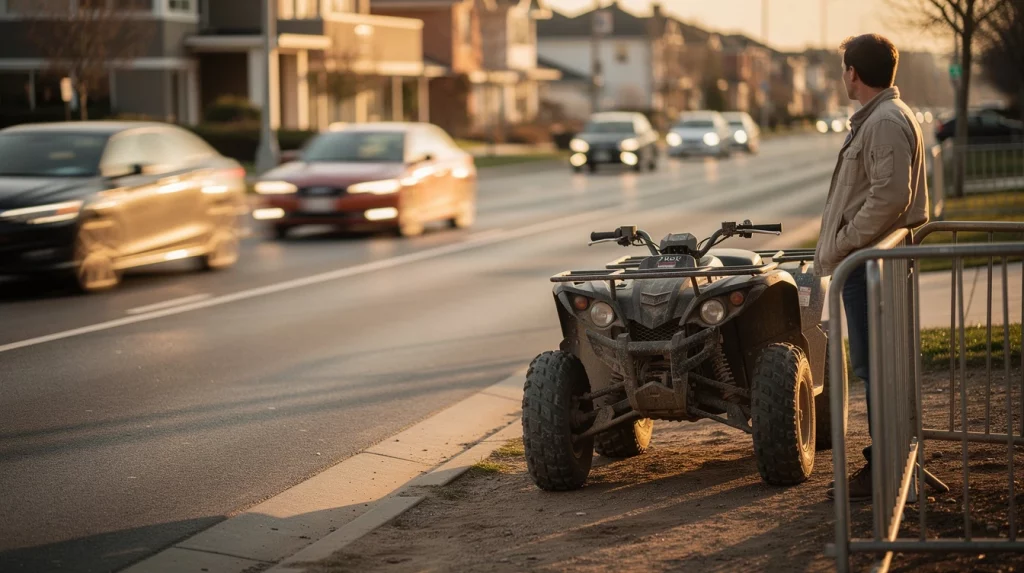
Most quads, also known as All-Terrain Vehicles or ATVs, are not street-legal because they lack essential safety equipment like turn signals, mirrors, and DOT-approved tires required by federal and state highway standards. Manufacturers build these vehicles strictly for off-road use, meaning they are not certified to meet the vehicle safety regulations required for registration on public roads.
Registration for an off-road vehicle depends entirely on state-specific laws that dictate whether an ATV can be converted or used on public infrastructure. While some states offer limited access, most do not permit standard quads on highways.
Most States Require Specific Safety Modifications for Road Use
State highway agencies require specific safety features before they will consider a vehicle for registration, which most off-road-only machines fail to include from the factory. A vehicle must be equipped with functional headlights, taillights, brake lights, turn signals, side-view mirrors, a horn, and a license plate light. These parts must be Department of Transportation (DOT) certified to satisfy state inspectors.
The Role of NHTSA Standards
The National Highway Traffic Safety Administration (NHTSA) sets the standards for all vehicles intended for use on public roads. Since ATVs are designed with solid rear axles and knobby off-road tires, they do not pass the high-speed handling or collision-safety requirements established by the NHTSA VIN lookup. When you look up a VIN for an ATV, the coding clearly identifies the unit for off-highway use only, which automatically flags it as ineligible for standard passenger vehicle registration in most jurisdictions.
Why Manufacturing Intent Limits Registration
Manufacturers issue a Manufacturer’s Statement of Origin (MSO) for every new vehicle, which designates the intended use. An MSO labeled ‘For Off-Road Use Only’ acts as a permanent descriptor. Because the vehicle was never crash-tested, airbag certified, or emission-tested for street use, attempting to register one as a standard car is effectively impossible in most states.
Montana LLCs Offer A Viable Pathway for Vehicle Assets

Forming a Montana LLC allows vehicle owners to register assets through a business entity, which is a common strategy for individuals who own various types of vehicles. Montana registration is popular because the state has no vehicle sales tax, which can save residents of high-tax states thousands of dollars on a single purchase. You can learn more about how this process works in our guide on The Complete Guide to Forming a Montana LLC for Vehicle Registration.
Ready to register your vehicle?
Join thousands of vehicle owners who use Dirt Legal to handle their registration quickly.
Register Your Vehicle Today →Asset Protection Through Montana LLCs
Using a Montana LLC vehicle registration adds a layer of liability protection between you and your assets. By holding the title in the name of the company, you separate your personal finances from the machine. This is a common practice for powersport collectors who maintain fleets of vehicles.
Why Sales Tax Matters for Registration Costs
Vehicle registration costs vary significantly by state, but Montana remains a favored location due to the absence of state-level sales tax. This helps offset the initial fees associated with forming an LLC and the annual registration filings. Review our Does Montana Have Sales Tax on Vehicles? Here is the Full Story guide for a deeper breakdown of the financial advantages.
| Feature | Standard ATV | Street-Legal Vehicle |
|---|---|---|
| Safety Lighting | None | Full DOT Set |
| Tire Rating | Off-Road | DOT Approved |
| Registration | Off-Highway | Full Highway Compliant |
| Sales Tax | Varies by State | Typically 0% in MT |
Compliance With State-Specific OHV Regulations

Every state maintains its own Off-Highway Vehicle (OHV) laws that define where and how machines can be operated on public land. These regulations often differentiate between quads, UTVs, and full-sized trucks, creating a complex patchwork of rules that change every time you cross a state line. For more insight, check out our guide on UTV Street-Legal States: Which States Allow Side-by-Sides on Public Roads.
Registration Cards vs Titles
Understanding the difference between a registration card and a title is critical for any owner. A title proves ownership, while a registration card allows for operation on designated public areas. What is the best proof of vehicle ownership? remains one of the most important questions for new owners, as a missing title can prevent you from registering the asset in any capacity.
Common Rejection Themes in DMV Paperwork
Documents are frequently rejected by DMV offices due to errors in odometer disclosures or missing signatures.
Frequently Asked Questions About Street-Legal Quads
Can I make my ATV street-legal by adding a light kit?
Adding a light kit is only the first step. To be street-legal, a vehicle must pass a state-level inspection where the equipment is verified against federal highway safety standards. Even with all the lights, many states still prohibit quads because their chassis, suspension, and steering systems are not engineered for high-speed highway use.
Why are UTVs more often street-legal than quads?
UTVs, or Side-by-Sides, are often classified differently in state statutes due to their roll cages, seat belts, and steering wheels. Many states have specific laws that allow UTVs on rural roads if the owner obtains the correct registration, whereas traditional quads lack the safety cage structure that officials prefer.
Do I need a motorcycle license for a street-legal ATV?
In most states that allow street-legal conversion for powersports, you are required to hold a valid driver’s license with a motorcycle endorsement. This is because the operation of a high-speed vehicle on public roads is treated similarly to riding a motorcycle in terms of safety and training.
How do I find out if my state allows street-legal ATVs?
You should check your state’s Department of Motor Vehicles or Department of Revenue website for ‘OHV’ or ‘ATV’ operation rules. These sites provide the exact statutes regarding road access, helmet requirements, and necessary equipment upgrades for your specific region.
What happens if I get caught riding a non-street-legal quad on the road?
If you operate an off-road-only vehicle on a public road, you risk fines, impoundment, and points on your driver’s license. Law enforcement officers have the authority to stop any vehicle that appears to be violating registration or safety equipment laws, regardless of whether you have an off-road registration sticker.
Understanding why there are no street-legal quads comes down to safety engineering and regulatory intent. While it is rarely possible to convert a traditional quad into a standard road-legal vehicle, owners can find options for managing their title and registration through professional services. Whether you are dealing with a Manufacturer’s Statement of Origin (MSO) or looking to pass a VIN inspection, having the right documentation is the foundation for a successful registration.