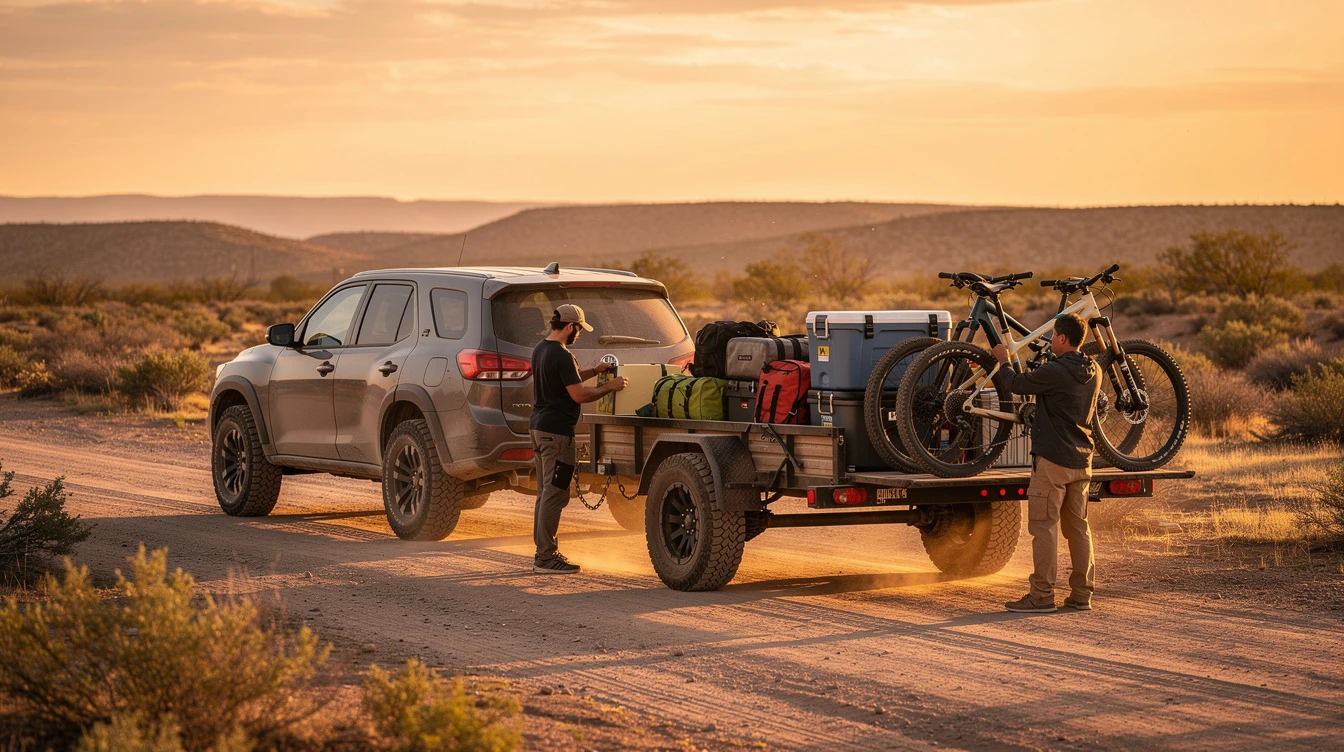
The 60/40 rule on trailers means that 60% of your cargo weight should sit in front of the trailer axle and 40% behind it, creating proper tongue weight for safe, stable towing. Get this wrong and your trailer can sway, fishtail, or become nearly impossible to control at highway speeds.
Why Does the 60/40 Rule on Trailers Matter for Safe Towing?
Proper weight distribution is the single biggest factor in trailer stability. When too much weight sits behind the axle, the trailer pushes up on the hitch ball and lifts the rear of your tow vehicle, reducing steering and braking control. The 60/40 rule keeps tongue weight in the safe zone, typically 10%, 15% of total trailer weight.
- Too much weight behind the axle: trailer sway, loss of steering, potential jackknife
- Too much weight forward: excess tongue weight, stressed hitch, rear suspension sag
- Balanced at 60/40: predictable handling, even braking, reduced sway risk
Honestly, more trailer accidents come from rear-heavy loads than from overloading. The physics are simple, but easy to overlook when you’re loading in a hurry.
How Do You Calculate the 60/40 Weight Distribution on a Trailer?
Start with your total cargo weight and divide it by the axle position. Place 60% of that weight forward of the axle centerline and the remaining 40% behind it. Most single-axle trailers measure from the coupler to the axle center to find the midpoint.
Ready to register your vehicle?
Join thousands of vehicle owners who use Dirt Legal to handle their registration quickly and hassle-free.
Register Your Vehicle Today → →Step-by-Step: Loading Your Trailer Correctly
- Weigh your total cargo before loading.
- Identify the axle centerline on your trailer.
- Multiply total cargo weight by 0.60, that’s your front-section target weight.
- Multiply total cargo weight by 0.40, that’s your rear-section target weight.
- Load heaviest items directly over or just forward of the axle.
- Place lighter items toward the rear.
- Use a tongue weight scale to verify before you hit the road, target 10%, 15% of gross trailer weight.
Quick note: tandem-axle trailers follow the same principle, but you measure from the midpoint between both axles instead of a single axle center.
What Happens If You Ignore the 60/40 Rule?
Rear-heavy trailers create dangerous sway that builds at speed. Once a trailer starts swaying, even experienced drivers struggle to recover. Beyond safety, improper loading can void your trailer’s warranty, lead to tire blowouts from uneven pressure, and cause frame stress that shortens the trailer’s life.
| Load Position | Effect on Tongue Weight | Handling Result | Risk Level |
|---|---|---|---|
| 60% front / 40% rear (correct) | 10%, 15% of GVW (ideal) | Stable, predictable | Low |
| 50% front / 50% rear | Below 10% of GVW | Mild sway at highway speed | Moderate |
| 40% front / 60% rear | Negative or near-zero tongue weight | Severe fishtail, sway | High |
| 70%+ front / 30% rear | Above 15% of GVW | Rear sag, poor steering | Moderate |
If your trailer doesn’t have a title or current registration, a traffic stop after a sway incident becomes a much bigger problem. Make sure your paperwork matches your equipment. A helpful resource: What Is the Best Proof of Vehicle Ownership? A Complete Document Guide walks through exactly which documents you need to have with you.
Does the 60/40 Rule Apply to All Trailer Types?
The 60/40 guideline is widely used across utility trailers, enclosed cargo trailers, flatbeds, car haulers, and horse trailers. The specific numbers can shift slightly depending on axle placement, but the principle holds: more weight forward of the axle than behind it.
- Gooseneck and fifth-wheel trailers: different hitch geometry, but front-heavy loading still applies
- Boat trailers: hull and engine weight typically land forward naturally, so less adjustment needed
- Car haulers: heavier vehicle goes on front of the deck to keep tongue weight positive
- Enclosed trailers: easiest to get wrong since you can’t see the load, mark your axle centerline inside
Tandem-axle trailers distribute load across two axles, so they’re more forgiving, but following 60/40 still produces the best handling results. Don’t assume more axles mean load position doesn’t matter.
Thinking about how your trailer is registered in your state? Montana registration can be a smart choice for owners who want to simplify the process. See how How to Register a Car in Montana Without Living There (The Complete Montana LLC Method) works, a process that applies to trailers and other vehicles too.
How Does Trailer Weight Distribution Connect to Registration and Titling?
Your trailer’s Gross Vehicle Weight Rating (GVWR) determines which registration class it falls into, and that affects title requirements, plate types, and annual fees. Load distribution affects how safely you can reach that GVWR, but the rated capacity is what the state cares about on paper.
- Trailers under 1,500, 2,000 lbs GVWR (varies by state): often title-exempt or low-fee registration
- Trailers over 2,000 lbs GVWR: typically require a title and full registration
- Commercial trailers: may require separate commercial plates and DOT compliance
Montana is one of the most owner-friendly states for trailer registration, with no sales tax, no emissions requirements, and straightforward titling. You can register your vehicle or trailer through a Montana LLC regardless of where you live, and Dirt Legal has helped 80,000+ vehicle orders to date get through the process.
For a complete breakdown of Montana registration costs and plate options, check out Montana Plates: Your Complete Guide to Options, Costs, and Registration.
If you’re forming an LLC to hold a trailer or other vehicle, the guide at The Complete Guide to Forming a Montana LLC for Vehicle Registration covers the full process step by step.
What Are Common Mistakes People Make With Trailer Weight Distribution?
Most loading mistakes aren’t intentional. They happen because people eyeball it or assume the trailer will handle fine. Here are the most common errors and how to avoid them.
- Loading by convenience, not by physics: heaviest items go in last, which means they often land at the back
- Ignoring tongue weight changes: a full water tank or fuel can in the rear shifts distribution fast
- Skipping the scale: a tongue weight scale costs under $50 and can prevent a serious accident
- Assuming tandem axles fix everything: they help, but don’t eliminate the need for proper distribution
- Not checking mid-trip: cargo shifts, especially loose items, redistribute weight as you drive
Before your next haul, consider whether your trailer’s title and registration are also in order. Outdated paperwork creates problems at weigh stations, during traffic stops, and at re-sale. Learn more about What Makes a Vehicle Title Invalid? Warning Signs Every Owner Should Know before it becomes an issue.
Frequently Asked Questions About the 60/40 Rule on Trailers
What is the 60/40 rule on trailers in simple terms?
The 60/40 rule means placing 60% of your cargo weight in front of the trailer axle and 40% behind it. This keeps tongue weight in the safe range of 10%, 15% of gross trailer weight, which produces stable, controllable towing. It’s the most widely used guideline for single-axle trailer loading.
What is the ideal tongue weight percentage for a trailer?
Most towing experts recommend keeping tongue weight at 10%, 15% of the trailer’s total loaded weight. Below 10% causes trailer sway. Above 15% overloads your hitch and causes rear sag in your tow vehicle. The 60/40 loading rule is the practical way to stay in that ideal range consistently.
Does the 60/40 rule apply to enclosed cargo trailers?
Yes. Enclosed trailers follow the same 60/40 principle but are harder to load correctly because you can’t see the axle from inside. Mark the axle centerline on the floor or wall with tape before loading. Heavy items, tools, and equipment go forward; lighter gear goes toward the rear doors.
What is title jumping and can it affect my trailer?
Title jumping happens when a vehicle or trailer is sold without the owner transferring the title first, leaving a gap in ownership records. It can make the trailer difficult to insure, register, or resell. Always make sure the title is transferred correctly at every sale to avoid ownership disputes later.
Do I need a title for my trailer in Montana?
Montana requires titles for trailers above a certain GVWR threshold, similar to most states. Trailers registered through a Montana LLC benefit from no sales tax and no emissions testing. Check Montana’s vehicle title and registration fee schedule for current thresholds and fees by trailer weight class.
Can I register a trailer in Montana if I don’t live there?
Yes. Non-residents can register your vehicle or trailer through a Montana LLC. Montana has no sales tax on vehicles, no annual inspections, and a straightforward registration process. Dirt Legal provides registration assistance for owners across the country, and we manage the out-of-state paperwork with our support.