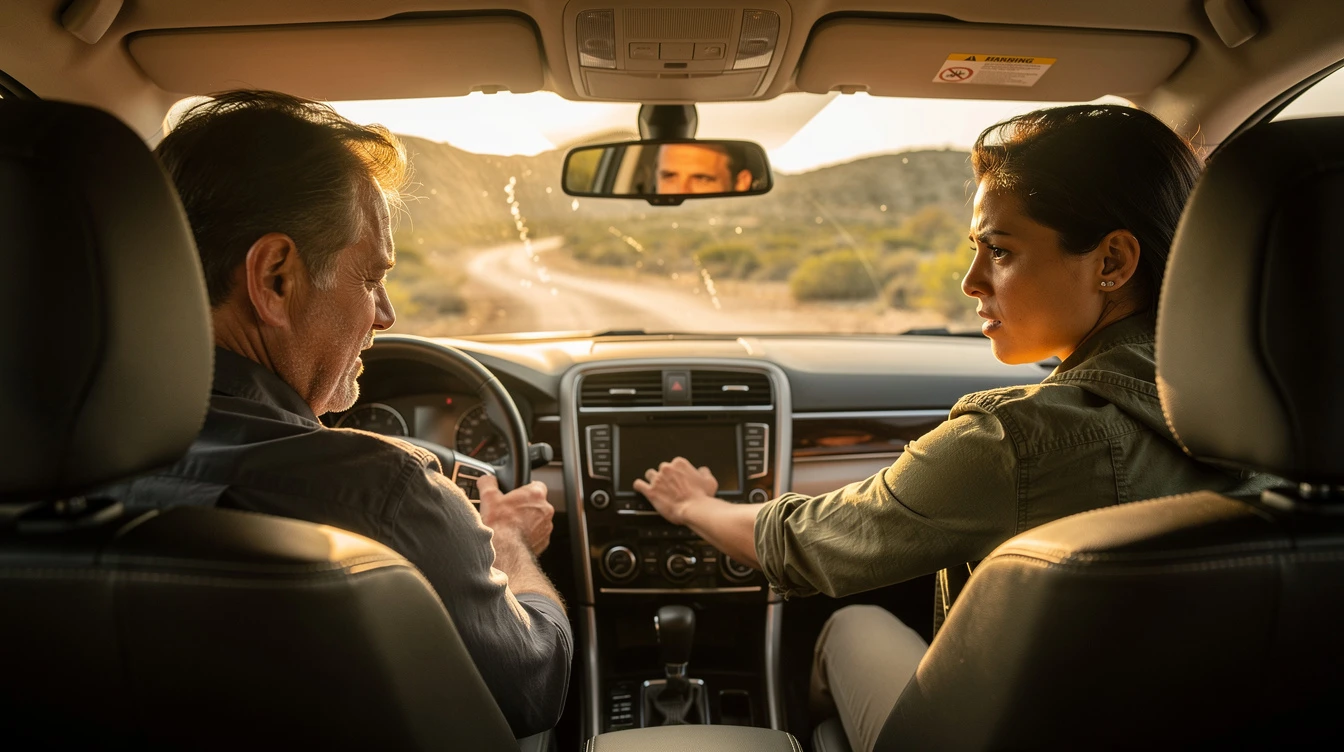
If the driver has a heart attack or stroke, your first job as a passenger in a car is to get the vehicle safely off the road, call 911, and keep the driver alive until help arrives. Every second counts, and knowing the right steps before an emergency happens could save a life.
What Should I Do First If the Driver Suddenly Becomes Unresponsive?
Stay calm and act immediately. Your first priority is stopping the vehicle without causing a crash, then getting emergency services on the line.
Here’s what to do, in order:
- Speak loudly to the driver. Shout their name. Sometimes a sudden loud stimulus can rouse someone who has briefly lost consciousness.
- Grab the steering wheel. Reach over and take control. Keep the car moving in a straight line or gently steer toward the shoulder.
- Shift to neutral or press the brake. If you can reach the gear selector, shift to Neutral (N). Alternatively, apply steady pressure to the brake pedal. Do not yank the emergency brake at highway speeds, as this can cause a dangerous spin.
- Signal and pull over. Turn on hazard lights. Guide the car onto the shoulder or into a parking lot. Aim for a flat, wide area away from traffic.
- Turn off the ignition. Once stopped, turn the key or press the Start/Stop button to cut the engine.
- Call 911 immediately. Tell the dispatcher your location, that the driver appears to be having a medical emergency, and whether the driver is breathing.
- Begin CPR if trained. If the driver is unresponsive and not breathing normally, start chest compressions at a rate of 100 to 120 compressions per minute, which is roughly the beat of the song “Stayin’ Alive.” Push down at least 2 inches into the chest.
How Is a Heart Attack Different From a Stroke, and Does It Change What I Do?
Both require the same immediate response from you as a passenger: stop the car safely and call 911. The distinction matters for the paramedics, not for your first actions.
Ready to register your vehicle?
Join thousands of vehicle owners who use Dirt Legal to handle their registration quickly and hassle-free.
Register Your Vehicle Today → →A heart attack (also known as a myocardial infarction) is a circulation problem, where a blocked artery stops blood from reaching the heart muscle. Symptoms a driver might show include clutching their chest, sweating heavily, or slumping forward suddenly. About 805,000 Americans have a heart attack every year, according to CDC data, and roughly 1 in 5 of those are silent, meaning the person may not appear distressed at all before losing control.
A stroke is a brain event caused by either a blocked blood vessel (ischemic stroke, which accounts for about 87% of all strokes) or a burst blood vessel (hemorrhagic stroke). Warning signs in a driver include sudden slurred speech, a drooping face on one side, or an arm going limp on the wheel. Time is especially critical with strokes because brain cells begin dying within minutes of blood flow being cut off.
In both cases, your role is identical: control the vehicle, stop safely, call for help, and stay with the driver.
What If I’m Sitting in the Back Seat When the Driver Has a Heart Attack?
This is harder, but not hopeless. The back seat creates physical barriers, and your reach to the steering wheel or brake will be limited depending on the vehicle.
- Lean between the seats and try to steer the car toward the shoulder or curb.
- Reach the gear selector if possible and shift to Neutral to let the car slow naturally.
- Call 911 immediately and keep the dispatcher on the line. They can talk you through what to do and alert emergency services to your GPS location.
- If the vehicle has a push-button ignition, holding the Start/Stop button for approximately 3 seconds will typically cut the engine, though the steering may lock in some vehicles, so only use this as a last resort at very low speeds.
- If the car is slowing on its own and heading toward a soft obstacle like a grassy median or a hedge, it may be safer to let it roll to a stop rather than overcorrect.
Honestly, this scenario is one of the strongest arguments for always sitting in the front passenger seat when possible on long drives, especially with older drivers or anyone with a known cardiac history.
How Do I Perform CPR on the Driver Once the Car Is Stopped?
CPR, short for cardiopulmonary resuscitation, is a technique that manually pumps blood through the body when the heart has stopped or is beating too weakly to sustain life. Standard hands-only CPR is something any adult can perform without training.
Steps for CPR in a vehicle emergency:
- Recline the driver’s seat as flat as it will go, or if possible, move the driver to the ground outside the car for a firmer surface.
- Position your hands. Place the heel of one hand on the center of the driver’s chest (the lower half of the breastbone). Put your other hand on top, fingers interlaced.
- Compress hard and fast. Push down at least 2 inches, at 100 to 120 compressions per minute. Do not stop to check for a pulse, keep compressing until paramedics arrive.
- If you’re trained in rescue breathing, give 2 breaths after every 30 compressions.
- Don’t stop. Survival rates for cardiac arrest drop by roughly 10% for every minute without CPR. Average emergency response time in the U.S. is about 7 to 14 minutes depending on location, so your compressions matter enormously.
The American Heart Association offers free hands-only CPR training resources that take under 2 hours to complete, and many fire stations offer free in-person sessions.
Prepared drivers carry proper registration, too. Make sure your vehicle paperwork is as ready as your emergency plan.
See How Vehicle Registration Works →What’s the Difference Between Stopping Safely vs. Stopping Fast?
Stopping fast can kill you and others. Stopping safely is a controlled process that takes 15 to 30 seconds but dramatically reduces the risk of a secondary crash.
| Scenario | Recommended Action | Risk Level |
|---|---|---|
| Highway at 65+ mph | Steer to shoulder, gradually apply brakes, hazards on | High, but manageable with gradual deceleration |
| City street at 30, 40 mph | Steer toward curb or parking lane, shift to Neutral, brake steadily | Moderate, watch for pedestrians |
| Stopped at traffic or low speed | Apply brake, turn off ignition, shift to Park | Low, most controllable scenario |
| Rear seat, limited reach | Guide steering between seats, call 911, let car decelerate naturally | High, prioritize slowing over steering precision |
| Push-button ignition vehicle | Hold button 3 seconds only at low speed as last resort | Moderate, steering lock risk |
The key principle: slow first, steer second, stop third. A car slowing down is far less dangerous than a car swerving unpredictably at full speed.
What Information Should I Give the 911 Dispatcher?
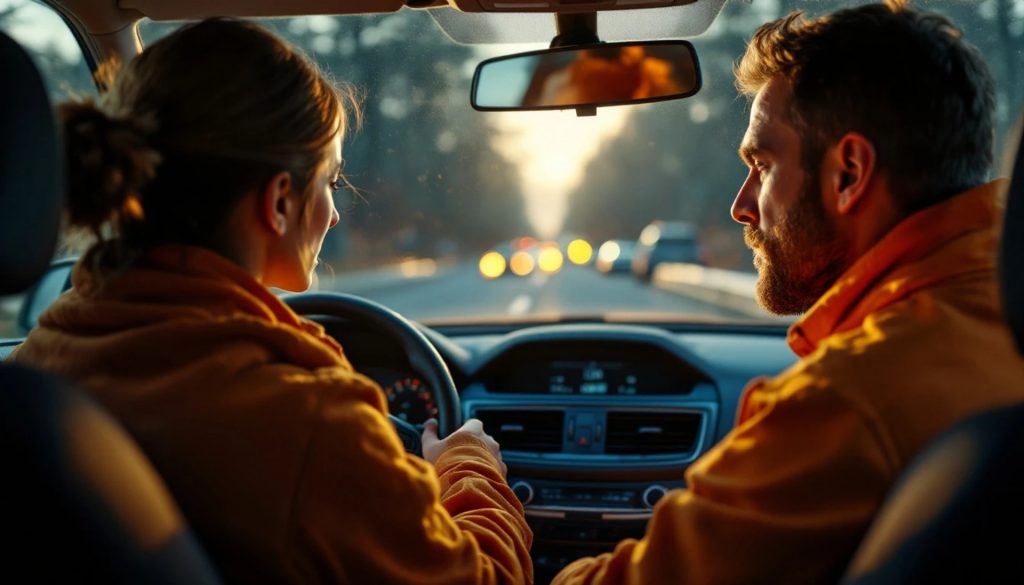
911 dispatchers are trained to help you through exactly this situation. Give them clear, short answers and let them guide you.
- Your exact location. Street name, highway number, mile marker, or nearest cross street. If you don’t know, say “I’m on [highway name] heading [direction] from [last city you passed].”
- What happened. “The driver appears to have had a heart attack” or “the driver suddenly slumped and isn’t responding.”
- Whether the driver is breathing. Look for chest movement and listen for breath sounds.
- The make, model, and color of the vehicle, so responders can identify you quickly.
- Whether the car is stopped or still moving. Stay on the line, the dispatcher will stay with you.
Do not hang up. Dispatchers can also relay your information to nearby highway patrol, which can reach you faster than an ambulance in some rural areas.
FAQ: Passenger and Driver Medical Emergency Questions
Can a passenger should take control of a moving vehicle from a driver having a heart attack?
Yes. In an emergency where the driver is incapacitated, any passenger taking control to prevent harm is acting in self-defense and defense of others. No state penalizes a passenger for grabbing the wheel to prevent a crash when the driver has a medical emergency. Emergency action is broadly protected under common law and most state statutes.
Should I pull the emergency brake to stop the car quickly?
Only at very low speeds, under 10 mph. At highway or city speeds, yanking the emergency brake causes the rear wheels to lock, which can send the car into an uncontrolled spin or rollover. A gradual application of the main brake pedal combined with steering to the shoulder is far safer than the emergency brake.
How long does someone survive a heart attack without help?
Survival depends on the type and severity, but without CPR or defibrillation, survival rates for sudden cardiac arrest drop by approximately 10% per minute. Brain damage can begin within 4 to 6 minutes of cardiac arrest. This is why calling 911 immediately and starting chest compressions without delay is so critical.
What is the FAST acronym for recognizing a stroke?
FAST is a medical mnemonic used to identify stroke symptoms: Face drooping, Arm weakness, Speech difficulty, Time to call 911. If a driver shows any one of these signs, treat it as a stroke emergency and pull over immediately. Stroke treatment is most effective within the first 3 to 4.5 hours of symptom onset.
Should I move the driver out of the car after stopping?
Only if the car is in an unsafe location, such as blocking a highway lane or near a fire hazard. Moving a stroke patient can worsen a hemorrhagic bleed. Moving a cardiac arrest patient to a flat surface improves CPR effectiveness. Use your judgment, and follow 911 dispatcher instructions if possible before moving the driver.
Does having a registered, properly titled vehicle matter in an emergency?
Yes, practically speaking. In an accident or emergency stop, police will ask for registration and proof of ownership. A vehicle without a valid title or registration can complicate towing, insurance claims, and liability. Making sure your vehicle paperwork is current protects you in exactly these unexpected roadside situations. Check out our guide on What Is the Best Proof of Vehicle Ownership? for a complete breakdown of what documents to keep in your vehicle.
Keeping your vehicle’s documentation in order also ties into broader ownership questions. Title Isn’t Always Ownership: The Reality Most People Miss is worth reading if you’ve recently bought or sold a vehicle and want to make sure the paperwork matches ownership.
If your registration is handled through a Montana LLC, our team at Dirt Legal has helped with 80,000+ vehicle orders to date.
Want to make sure your vehicle is properly registered before you hit the road? See Simple Process, No Extra Steps: Your Vehicle Registration Handled Without Delays for a straightforward overview, or The Complete Guide to Forming a Montana LLC for Vehicle Registration if you’re considering the Montana LLC path.
For riders and powersport owners, our sister brand covers registration-specific concerns in detail, including why exotic car insurance is only as strong as its registration, a point that applies to any vehicle you depend on daily.
Your vehicle should be as ready as you are. Get your registration sorted with Dirt Legal’s remote paperwork support.
Start Your Registration Today →