The difference between a Jeep and a Humvee (officially the HMMWV, short for High Mobility Multipurpose Wheeled Vehicle) is bigger than most people realize. Both are rugged, four-wheel-drive machines built for tough terrain, and both carry serious military heritage. But their origins, sizes, purposes, and civilian lives couldn’t be more different.
This guide breaks down everything side by side, from battlefield history to what it costs and what it takes to title and register one for street use. If you’re thinking about buying a surplus military vehicle, or just curious how these two icons compare, you’re in the right place.
Quick heads-up: if you already own an ex-military vehicle or an off-road rig and need help sorting the paperwork, Dirt Legal handles DMV filings on your behalf so you don’t have to fight the complex paperwork alone.
The Origins of the Jeep vs. the Humvee or HMMWV
Where Did the Jeep Come From?
The Jeep traces its roots to World War II. In 1940, the U.S. Army issued a spec for a lightweight, general-purpose reconnaissance vehicle. Willys-Overland won the contract, and the result was the MB, a compact, 2,450-lb machine that could haul personnel, mount weapons, and go almost anywhere.
After the war, Willys released the civilian CJ series (CJ stood for “Civilian Jeep”), and the brand never looked back. Today’s Jeep Wrangler is a direct spiritual descendant of that WWII design. It’s lighter, more refined, and packed with modern tech, but the DNA is unmistakable.
Where Did the Humvee Come From?
The HMMWV entered service in 1985, built by AM General to replace the aging Jeep M151 in U.S. military use. The Army wanted something that could do many jobs at once: transport troops, carry weapons systems, serve as an ambulance, and handle every climate on earth. What they got was a 5,200-lb (base) beast sitting 16 inches off the ground, wide enough that it earned a reputation for dominating any terrain it touched.
AM General released a civilian version in 1992, called the Hummer H1. Arnold Schwarzenegger famously pushed for civilian access after watching them during a National Guard filming. The H1 became a cultural icon through the 1990s before General Motors acquired the brand and launched the H2 and H3 (which are Chevy Tahoe and Colorado platforms underneath, not true HMMWVs).
Why the Confusion Between the Two?
Both vehicles served in U.S. military operations. Both are four-wheel-drive. Both look tough. But the comparison basically ends there. The Jeep was designed for speed and agility on rough ground. The HMMWV was designed for mission versatility and surviving punishment. They were solving different problems.
Size, Weight, and Specs: A Direct Comparison
Physical Dimensions
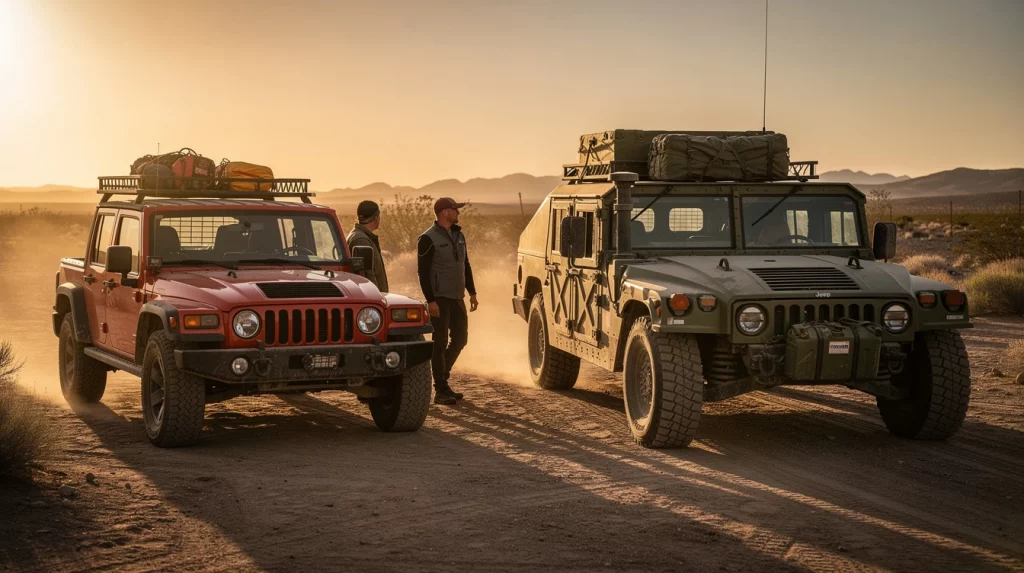
The size gap between a Jeep and an HMMWV is jarring in person. A standard Jeep Wrangler two-door sits roughly 154 inches long, 74 inches wide, and weighs around 4,000 lbs depending on trim. An HMMWV stretches roughly 180 inches long, a staggering 86 inches wide, and tips the scales at 5,200 lbs in its lightest configuration, with armored variants reaching well over 10,000 lbs.
undefinedThat extra width is why HMMWVs look like they’re taking up both lanes. The wide stance gives them incredible stability, but it also makes them challenging to drive on narrow roads and nearly impossible to park in a standard spot.
Engine and Drivetrain
Early military Jeeps ran four-cylinder engines with a three-speed manual. Modern Wranglers offer a range of powertrains, including a 2.0L turbocharged four-cylinder and a 3.6L V6, with optional four-wheel-drive systems ranging from part-time to full-time.
The HMMWV originally ran a 6.2L naturally aspirated diesel V8, later updated to a 6.5L turbodiesel. The four-wheel-drive system is full-time with a two-speed transfer case, and the independent suspension on all four corners gives it serious axle articulation. Ground clearance of 16 inches means it can walk over obstacles that would stop most trucks cold.
Off-Road Capability
Honestly, both are capable off-road machines, but they’re capable in different ways. A Jeep Wrangler with a lift kit and 35-inch tires is a fantastic trail vehicle. It’s nimble, easy to maneuver on tight switchbacks, and light enough that recovery is manageable if you get stuck.
An HMMWV is built for sustained, heavy-use operations in any environment, including water fording up to 60 inches deep with the deep water fording kit. It won’t slip through tight forest trails the way a Wrangler can, but it will cruise through a flooded road or scale a 60% grade without flinching. Different tools, different jobs.
Civilian Use: Can You Actually Drive a Humvee on the Road?
Are Surplus HMMWVs Street-Legal?
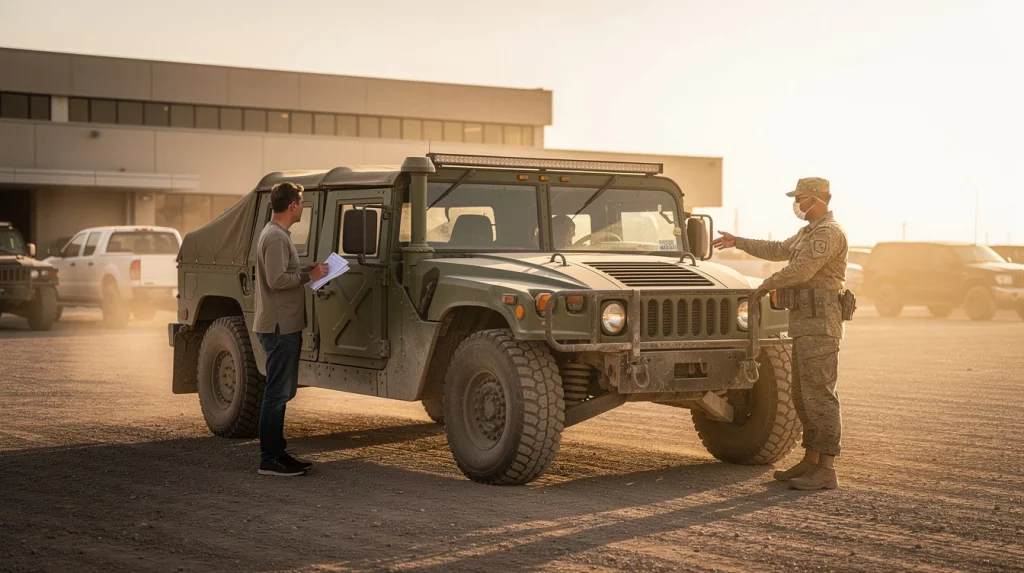
This is where things get interesting. Thousands of surplus HMMWVs have been sold through government auctions to civilians over the years. They can technically be made street-legal in most states, but the process isn’t simple. Most surplus military vehicles come without a traditional title, which creates immediate registration headaches.
The paperwork trail matters. A vehicle VIN inspection may be required depending on your state, and you’ll likely need to document the chain of ownership carefully. If the vehicle came through a government auction with a bill of sale but no title, you may need to pursue a bonded title or other alternative title process before you can register it. A more detailed breakdown of that process is available in our guide, Should You Buy a Car Without a Title? What to Know Before Buying a Car Without a Title, which covers what documentation you need and what risks to watch for.
For motorcycle and powersport owners dealing with similar paperwork issues, the team at Ride Legal covers bonded titles in detail and when they apply.
Registering a Surplus Military Vehicle Through Montana
One popular path for owners of surplus or unusual vehicles is Montana LLC vehicle registration. Montana has no sales tax, no emissions testing requirements, and a relatively straightforward registration process for vehicles that don’t fit neatly into standard DMV categories. Many owners of vintage and military vehicles use this route to avoid paying sales tax on high-value machines and sidestep emissions hurdles that don’t apply to older equipment.
If that sounds like it might fit your situation, see how the process works at Dirt Legal. The team handles the Montana LLC formation and DMV paperwork on your behalf.
What About the Civilian Hummer H1, H2, and H3?
The civilian H1 (produced 1992,2006) is titled and registered like any other vehicle. It came with a standard Manufacturer’s Certificate of Origin, so the title chain is typically clean. The H2 and H3 are General Motors products built on truck platforms and register with no more difficulty than any SUV. The confusion mostly arises around true military surplus HMMWVs, not the consumer versions.
| Feature | Jeep Wrangler (Current) | HMMWV (M998 Base) |
|---|---|---|
| Origin | WWII U.S. Army, 1940s | U.S. Army, 1985 |
| Manufacturer | Willys / Chrysler / Stellantis | AM General |
| Civilian Version? | Yes, always | Yes, H1 (1992,2006) |
| Curb Weight | ~4,000 lbs | ~5,200 lbs (base) |
| Width | ~74 inches | ~86 inches |
| Ground Clearance | ~10 inches (stock) | 16 inches |
| Engine (base) | 2.0L Turbo / 3.6L V6 | 6.2L or 6.5L Diesel V8 |
| Water Fording Depth | ~30 inches (stock) | Up to 60 inches (with kit) |
| Street-Legal (civilian)? | Yes, standard | Possible, varies by state |
| Fuel Economy (est.) | 22,29 MPG (combined) | ~8,10 MPG |
| Average Price (used) | $25,000,$50,000 | $10,000,$30,000+ (surplus) |

Ready to register your vehicle?
Join thousands of vehicle owners who use Dirt Legal to handle their registration quickly and hassle-free.
Register Your Vehicle Today → →Titling and Registration: What Owners Need to Know
Titling a Surplus HMMWV
Military surplus vehicles present some of the trickier title scenarios in the DMV world. They were originally owned by the federal government, which doesn’t issue standard vehicle titles. When they’re sold through auction, you typically receive a Standard Form 97 (SF-97), which is the government’s version of a title document. Most states will accept an SF-97 to issue a state title, but requirements vary.
Some states also require a vehicle VIN inspection before issuing a title on a vehicle with an unusual history. Getting that inspection done the first time matters correctly, because rejected applications slow everything down. For a broader look at what can cause registration delays and how to avoid them, this guide on why vehicle registration gets rejected is worth reading before you start.
For many military vehicle owners, the hardest part is not buying the HMMWV — it is figuring out how to navigate a DMV system that rarely deals with military surplus paperwork correctly. Delays, rejected applications, and conflicting answers are extremely common, especially when an SF-97 or unusual title history is involved.
Title Jumping and Military Vehicles
One issue that sometimes comes up with surplus vehicles sold through informal channels is title jumping, which happens when a vehicle is sold without properly transferring the title at each step. If an HMMWV was auctioned to one buyer, sold to a second without a title transfer, and then offered to you, that chain creates problems. You may be holding a vehicle with no clear title path.
Title jumping carries real penalties in most states. Our article on The 5 Biggest Out-of-State Registration Mistakes (And How to Avoid Them) covers what happens when ownership chains break down and how to get back on track.
Registering a Jeep From Another State
Standard Jeep Wranglers and other consumer Jeep models are straightforward to register, but out-of-state transfers can get complicated. A DMV title transfer requires the signed title from the seller, a bill of sale in most states, proof of insurance, and sometimes a VIN inspection. Missing any one of those steps can delay or derail the process.
Which One Is Right for You?
Daily Driver vs. Collector or Specialty Vehicle
If you want something you’ll actually drive every day, a Jeep is the clear answer. Modern Wranglers are refined enough for highway commutes, comfortable enough for long trips, and small enough to park at a grocery store without causing a scene. You can get one brand new with a factory warranty, full dealer support, and parts available at every auto parts store in the country.
An HMMWV is a specialty vehicle and should be treated as one. Parts availability is improving (there’s a healthy aftermarket and a strong community), but the fuel costs alone (around 8 MPG on a diesel V8) make daily use expensive. Most civilian HMMWV owners use them for off-road events, overland builds, or as collector pieces. A few use them as farm or ranch vehicles where the width and ground clearance are genuine advantages.
Cost Considerations
The sticker price on a surplus HMMWV can be deceiving. You might find one at government auction for $10,000 to $15,000, but factor in the cost of a title process (especially if you’re working from an SF-97 or bill of sale only), any required inspections, registration fees, insurance (which can be tricky on military vehicles), and potential mechanical work. Total cost of ownership adds up fast.
A new Jeep Wrangler starts around $33,000 and climbs well past $55,000 for a loaded Rubicon. Used examples range from $20,000 to $45,000 depending on age and trim. The registration process is standard, parts are cheap, and dealers are everywhere. For most buyers, the Jeep wins on total convenience.
UTVs and Side-by-Sides: A Third Option?
Some buyers exploring the Jeep vs. Humvee question are really asking something broader: what’s the best capable off-road vehicle for their needs? Side-by-sides and UTVs have become seriously competitive in the off-road space, and many can be made street-legal depending on your state. If that sounds interesting, Can You Make a UTV Street Legal in Montana? is a solid starting point, and the team at Ride Legal also covers registering a side-by-side for street use in detail.
Frequently Asked Questions: Jeep vs. Humvee or HMMWV
What does HMMWV stand for?
HMMWV stands for High Mobility Multipurpose Wheeled Vehicle. It entered U.S. military service in 1985, manufactured by AM General. The nickname “Humvee” comes from the acronym HMMWV spoken phonetically. The civilian version, sold by AM General from 1992 to 2006, was marketed as the Hummer H1. General Motors later produced the H2 and H3, which are separate vehicles on commercial truck platforms and are not military-derived machines.
Is the Hummer H2 the same as a military HMMWV?
No. The Hummer H2 (produced 2003,2009) is a General Motors product built on the GMT800 truck platform, the same architecture as the Chevy Tahoe and Suburban. It looks large and angular, which creates the visual association, but it shares no engineering with the actual HMMWV. The only true civilian HMMWV derivative was the original Hummer H1, which AM General produced on the actual military platform with civilian modifications including a quieter interior and air conditioning.
Can civilians buy and drive a surplus HMMWV?
Yes, in most cases. Surplus HMMWVs are regularly sold through government auctions, and they can be registered for street use in most states. The process typically requires presenting the government-issued title document (Standard Form 97) to your state DMV, obtaining a VIN inspection in some states, and completing a standard registration. Some states have additional requirements for vehicles over a certain weight. Working through the paperwork with a vehicle registration service can save significant time and reduce errors.
Why is the HMMWV so much wider than a Jeep?
The extra width is a deliberate military design choice. The HMMWV’s 86-inch track width (compared to roughly 74 inches for a Wrangler) gives it a very low center of gravity relative to its height, which allows it to operate on steep side slopes without rolling. The military needed a vehicle that could carry heavy weapon systems, armor, and equipment without becoming unstable. That same width, however, makes parking in civilian settings a challenge and limits access to narrow trails where a Jeep excels.
Which is better off-road, a Jeep or a Humvee?
It depends on the terrain and the mission. The HMMWV has more ground clearance (16 inches vs. roughly 10 on a stock Wrangler), superior water fording capability, and can handle sustained abuse over long distances with heavy loads. A Jeep Wrangler is more maneuverable on tight trails, easier to recover if stuck, and more capable with aftermarket modification for technical rock crawling. For overlanding or trail riding, many enthusiasts prefer a Wrangler. For sustained off-road operations carrying heavy gear, the HMMWV is hard to match.
Do I need a special license to drive a Humvee on public roads?
In most states, a standard driver’s license is sufficient for a civilian HMMWV below the weight threshold that triggers commercial vehicle licensing (typically 26,001 lbs gross vehicle weight rating). Most HMMWV variants fall well below that threshold, so a Class C or standard license applies. That said, state rules vary, and some areas have additional requirements for vehicles with military markings or unusual configurations. Always check with your state DMV before operating a newly purchased surplus vehicle on public roads.
What happens if I buy a surplus military vehicle without a proper title?
If the seller can’t provide an SF-97 or a clean state title, you may need to pursue a bonded title or other alternative title method to register the vehicle. Title floating (holding a vehicle without properly transferring ownership) and title jumping (skipping steps in the ownership chain) both create legal and registration problems. A bonded title requires purchasing a surety bond to indemnify anyone with a prior claim on the vehicle. The process varies by state. A vehicle registration service can help you identify the right path based on your documentation. For more context on what a bonded title involves, this guide on bonded titles covers the basics clearly.
Can I register a surplus HMMWV in Montana to avoid sales tax?
Montana has no sales tax on vehicle purchases, which is one reason many high-value vehicle owners choose to register through a Montana LLC. This applies to specialty and military vehicles as well as standard passenger cars. A Montana LLC holds the title to the vehicle, and the LLC pays no sales tax at the point of purchase. There are rules around residency and proper use of the LLC structure, so it’s worth understanding how the process works before proceeding. Dirt Legal handles Montana LLC formation and registration as a complete service.
The Bottom Line on Jeep vs. Humvee or HMMWV
The difference between a Jeep and a Humvee comes down to purpose, scale, and mission. The Jeep was born as a lightweight, fast-moving reconnaissance vehicle and grew into the civilian off-road icon it is today. The HMMWV was purpose-built as a heavy, multi-mission military platform that could survive anything. Both are capable, both are iconic, and both attract passionate owners.
What they share is a registration reality: getting either vehicle properly titled and on the road requires documentation, compliance, and attention to paperwork. Whether you’ve bought a surplus HMMWV at government auction or picked up a used Wrangler across state lines, the title and registration process matters. Dirt Legal handles that complexity on your behalf, from Montana LLC registration to out-of-state title transfers, so you spend more time behind the wheel and less time dealing with the DMV.