Swapping an ATV or motorcycle engine into a kei mini truck is one of those projects that sounds straightforward until you actually start pulling parts. The mechanical side is doable, but there are real hurdles around fabrication, registration, and making the finished build street-legal. This guide breaks down exactly what you’re getting into, from the engine bay to the DMV paperwork.
Whether you’re building a farm runner, a trail machine, or something that can pull double duty on back roads, you’ll want to know the full picture before you buy a donor engine. We’ll cover the mechanical difficulty, the title and registration questions, and what your options look like when the build is done.
The short version? It’s a moderate-to-hard project with a few smart paths through the registration side, and knowing those paths ahead of time saves a lot of headaches later.
What Makes a Kei Truck Engine Swap Appealing in the First Place?
Kei trucks, the compact Japanese mini trucks like the Suzuki Carry, Daihatsu Hijet, and Honda Acty, have a dedicated following in the U.S. They’re light, simple, and surprisingly capable. The factory engines are usually small-displacement units in the 550cc to 660cc range. Reliable, yes. Exciting, not exactly.
ATV and motorcycle engines occupy the same displacement territory but are often tuned for more aggressive output. A 700cc sport ATV engine can push significantly more horsepower than a stock kei truck motor of similar size. That gap is what makes the swap idea attractive, especially for off-road use or farms where you want a little more grunt without adding weight.
Which Engines Are People Actually Using?
The most common donor engines come from sport ATVs and single-cylinder or parallel-twin motorcycles. Honda TRX, Yamaha Raptor, and Kawasaki Brute Force powerplants all get mentioned in forums. On the motorcycle side, single-cylinder thumpers from dual-sport bikes are popular for their torque characteristics. Mid-size inline-fours from sport bikes show up too, though they bring their own complications around mounting and cooling.
Why Kei Trucks Are a Reasonable Candidate
These trucks have open, accessible engine bays and relatively simple drivetrains. The mid- or rear-engine layout on many models gives you usable space to work with. The frames are lightweight steel, which is weldable and modifiable without exotic tooling. That accessibility is a real advantage when you’re doing custom fab work.
How Difficult Is the Actual Engine Swap? A Realistic Look
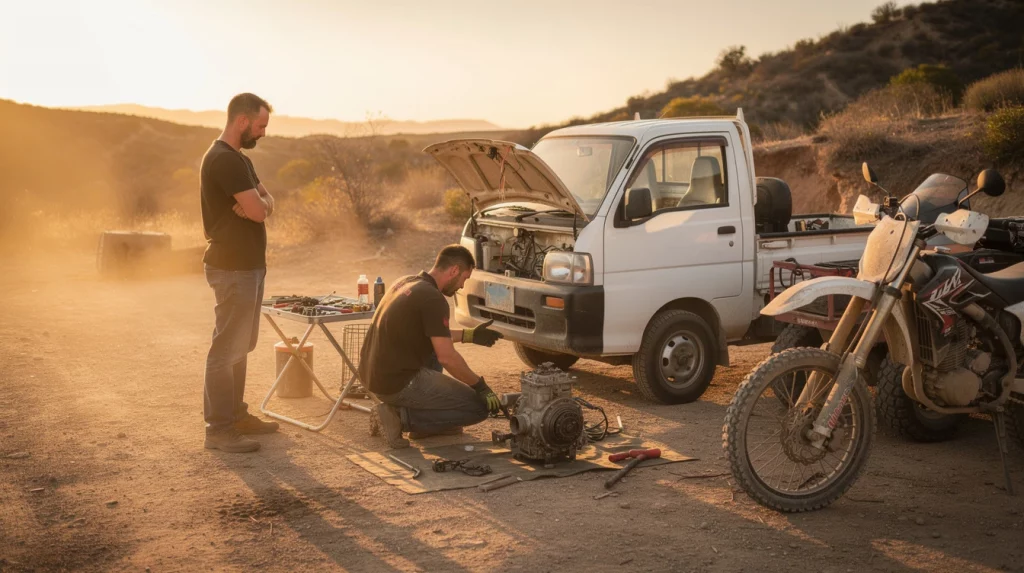
Honestly, “difficult” depends a lot on your fabrication skills and what tools you have access to. This is not a bolt-in swap, full stop. There is no off-the-shelf kit for most engine-and-truck combinations, which means you’re building custom motor mounts, figuring out driveline connections, and solving cooling and fuel delivery from scratch.
undefinedMotor Mount and Drivetrain Fabrication
This is where most builders spend the most time. Kei trucks typically use a transaxle layout, and the donor engine needs to mate to that drivetrain somehow. ATV engines often have integrated transaxles of their own, which adds complexity. You may be building a custom adapter plate, modifying an existing bellhousing, or rethinking the driveline entirely. If welding and metalwork aren’t in your skill set, budget for a fabricator.
Cooling, Fuel, and Electrical Systems
Water-cooled ATV engines need a radiator relocation or a custom cooling circuit. Air-cooled engines simplify this but create heat management questions in an enclosed bay. Fuel systems need to match the donor engine’s requirements, whether that’s carburetor, single injector, or full EFI. Electrical integration, getting the donor engine’s ignition and sensors to talk to the truck’s wiring, can range from simple to deeply frustrating depending on the combination you choose.
Time and Cost Estimates
A realistic DIY estimate for a competent home builder runs 80 to 200+ hours of labor. Parts costs for the donor engine, fabrication materials, and supporting components typically land between $1,500 and $5,000 depending on the engine choice. If you’re paying a shop for fab work, that number climbs fast. Plan conservatively, because custom builds always run longer and more expensive than the initial estimate.
The Registration Reality After a Major Engine Swap
Here’s where things get interesting, and where a lot of builders get caught off guard. A significant engine swap, especially one that changes the engine type, displacement class, or manufacturer, often triggers a retitling process with your state DMV. Ignore this and you can end up with a truck that has no clear title path, which creates problems when you want to sell, insure, or register it for road use.
What Triggers a Title Issue
Most states track vehicles by VIN and the engine number when applicable. When you swap to a non-original engine, the VIN still identifies the chassis, but any documentation that references the original engine number may no longer match. Some states require a vehicle registration update when you make a major drivetrain modification. Others want a physical inspection. A few don’t ask at all. The variation is wide.
VIN Inspections and Modified Vehicles
If your state requires a VIN inspection before registering a modified vehicle, the inspector will verify the chassis VIN matches the title and check that no stolen components are present. This is generally not a problem on a clean kei truck with a donor engine, but you want clean paperwork on both the chassis and the donor vehicle. Learn more about how VIN checks work and why they matter before you start sourcing parts.
Montana LLC registration as an Option
One path that modified vehicle owners use is registering through a Montana LLC vehicle registration. Montana has no sales tax, no emissions testing, and no annual safety inspections at the state level. For a highly modified vehicle that might not pass a strict inspection in your home state, Montana registration through an LLC is worth understanding. The process is well-established, and Dirt Legal handles the paperwork. You can read a broader overview of why Montana LLC vehicle registration matters for modified and specialty vehicles.
| Engine Type | Typical Displacement | Swap Difficulty | Cooling Type | Registration Impact |
|---|---|---|---|---|
| ATV Sport Engine (e.g., Yamaha Raptor) | 700cc | High, custom drivetrain needed | Liquid | Likely triggers inspection |
| ATV Utility Engine (e.g., Honda Rancher) | 420cc, 520cc | Moderate, simpler torque curve | Air or Liquid | Likely triggers inspection |
| Dirt Bike / Dual Sport Single | 250cc, 450cc | Moderate, adapter work required | Air or Liquid | May trigger inspection |
| Motorcycle Inline-Four | 600cc, 1000cc | Very High, significant fab required | Liquid | Almost always triggers inspection |
| Stock Kei Truck Engine (for reference) | 550cc, 660cc | Bolt-in, no modification | Air or Liquid | No impact |
Street-Legal Considerations for Swapped Kei Trucks
Getting a kei truck street-legal after a major engine swap is a separate question from just completing the mechanical build. The rules vary significantly by state, and what flies in one place may fail inspection in another. Knowing this before you start can shape which engine you pick and how you document the build.
What States Typically Look For
Street-legal requirements for modified vehicles generally include working lights, mirrors, horn, brakes, and in some states, a functional speedometer tied to the actual drivetrain. A swapped engine doesn’t automatically fail any of those checks, but if the swap changes the driveline in a way that affects the speedometer or brake assist systems, those need to be addressed. States with emissions testing will want to know the engine year and origin, which can complicate things with older or off-road-only donor engines.
Off-Road vs. Street Registration
Many kei truck owners with heavily modified builds register for off-road or farm use only, which sidesteps the street-legal complexity entirely. If your goal is trail riding, farm work, or private land use, this is a clean and easy path. If you want road access, the paperwork gets more involved. Check out what’s involved in making a UTV street legal in Montana as a reference point, since the compliance framework is similar for heavily modified small vehicles.
Importing a Kei Truck First
Many kei trucks in the U.S. are Japanese imports. Getting the title sorted on the chassis before you start modifications is strongly recommended. A vehicle without a clear title going into a build is a vehicle without a clear title coming out. Read the full breakdown on importing a vehicle to the U.S. if you’re still in the acquisition phase. Getting the title right first protects your investment in the build.
Title and Documentation: Sorting It Out Before and After the Build
The paperwork side of a custom build is often the last thing people think about and the first thing that causes problems. A kei truck that’s been swapped with an ATV engine is still a vehicle, and it still needs a title, registration, and in most states some form of insurance to operate on public roads.
If Your Kei Truck Has No Title
Some kei trucks come into the country without a clear chain of title, especially older imports. If that’s your situation, a bonded title may be your path forward. Learn more about what a bonded title is and when you need one before you invest heavily in a build on a truck that may have title complications. Sorting this first is significantly easier than doing it after the engine swap is complete.
Bill of Sale Documentation for Donor Engines
Keep a proper bill of sale for the donor engine. This is basic practice for any custom build and protects you if questions arise about the engine’s origin. A well-documented bill of sale for the donor vehicle or parts creates a paper trail that makes registration and potential resale much cleaner. Don’t skip this step.
Registering a Modified Vehicle Through Montana
Montana’s registration process doesn’t require emissions inspections, which makes it a realistic option for custom and modified vehicles. The state has well-established procedures for registering non-standard vehicles, and a Montana LLC registration can cover your kei truck regardless of the engine inside it. Dirt Legal handles the LLC formation and registration paperwork, so you’re not dealing with the Montana DMV directly. You can also read about the hidden perks of a Montana license plate to understand the full picture of why this option appeals to custom builders.
Frequently Asked Questions
Is an ATV engine a direct bolt-in for a kei truck?
No. There are no direct bolt-in swaps for ATV or motorcycle engines into kei mini trucks. The motor mounts, driveline connections, and supporting systems all require custom fabrication. The amount of work depends on the specific engine and truck combination, but plan on building custom mounts and adapter solutions regardless of what engine you choose. This is a skilled fabrication project, not a parts-swap job.
Will swapping the engine affect my kei truck’s title?
It depends on your state. Some states require you to update the title or notify the DMV when you make major mechanical changes, especially engine replacements that change the displacement or engine type. Others only track the chassis VIN and don’t care about the engine. Check your state’s DMV requirements before starting. If you’re unsure, registering through a Montana LLC sidesteps many of these requirements entirely since Montana doesn’t have emissions testing or mandatory mechanical inspections.
Can I make a kei truck with a swapped engine street-legal?
In most states, yes, but the path depends on local requirements. Street-legal status for modified vehicles typically requires the standard safety equipment: lights, mirrors, horn, brakes, and sometimes an emissions check. The engine swap itself doesn’t automatically fail those checks, but if the donor engine is an off-road-only unit with no emissions compliance history, some states will have questions. Off-road registration is often the simpler path for heavily modified kei trucks. See our guide on making a UTV street-legal in South Dakota for a comparable registration framework.
What’s the cheapest engine swap option for a kei mini truck?
Single-cylinder dirt bike or dual-sport motorcycle engines in the 250cc to 450cc range tend to be the most affordable donor options and are often simpler to mount due to their compact size and simple drivetrain. Air-cooled options remove the radiator relocation challenge. Used engines from popular platforms like the Honda XR or Yamaha WR series are widely available and reasonably priced. That said, “cheap” on the engine itself can still mean significant fabrication costs to make it work in the chassis.
Do I need to do a VIN inspection after swapping an engine in a kei truck?
Some states require a VIN inspection when registering a vehicle with a non-original engine, especially if the engine number was previously recorded on the title. The inspection verifies the chassis VIN and confirms no stolen components. If your kei truck and donor engine both have clean documentation, this is typically a formality. Montana registration through an LLC does not require a physical inspection at the state level, which is one reason builders in strict-inspection states look at that option. Read more about how vehicle registration laws work across states to understand what your state may require.
Can I register a kei truck through a Montana LLC if it has a non-stock engine?
Yes. Montana doesn’t have state emissions testing or mandatory mechanical safety inspections for registration purposes. The registration process through a Montana LLC is based on the vehicle’s title and the LLC formation, not the engine configuration. This makes Montana a popular choice for custom builds, modified vehicles, and imported specialty vehicles. Dirt Legal handles the complete process, from LLC formation to title and plates. Montana vehicle registration costs are also generally lower than many other states, which adds to the appeal for custom builds.
What happens if I try to sell a kei truck with a swapped engine later?
Resale is straightforward if you have clean documentation: a clear title on the truck, a bill of sale for the donor engine, and registration that reflects the current state of the vehicle. Problems arise when the title still shows the original engine specs and the buyer’s state has strict inspection requirements. Keeping good records throughout the build protects your resale value. If the title situation is unclear, a bonded title process can establish clear ownership. Learn more about salvage vs. clean title considerations as you think through what documentation approach fits your build.
The Bottom Line on Kei Truck Engine Swaps
Putting an ATV or motorcycle engine into a kei mini truck is a legitimate project with a real payoff in performance and customization. The mechanical difficulty is moderate to high, the fabrication work is real, and the registration side requires some planning. None of that is insurmountable.
The builders who come out the other side with a working, registered truck are the ones who sorted the paperwork as carefully as they sorted the engine mounts. A clean title going in, good documentation on the donor engine, and a clear plan for registration when the build is done. That’s the formula.
If your home state makes registration difficult for modified vehicles, Montana LLC registration is worth a serious look. No emissions testing, no mandatory inspections, and straightforward paperwork handled by people who do this every day.