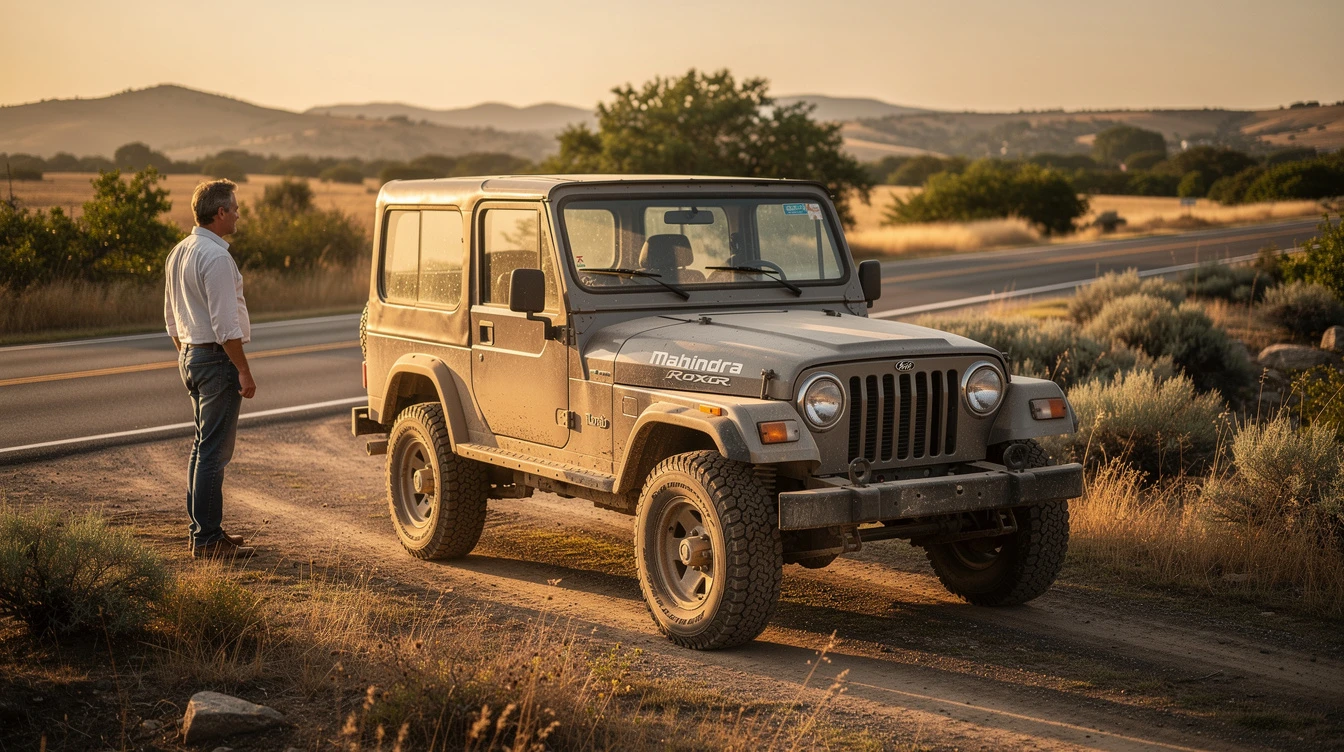
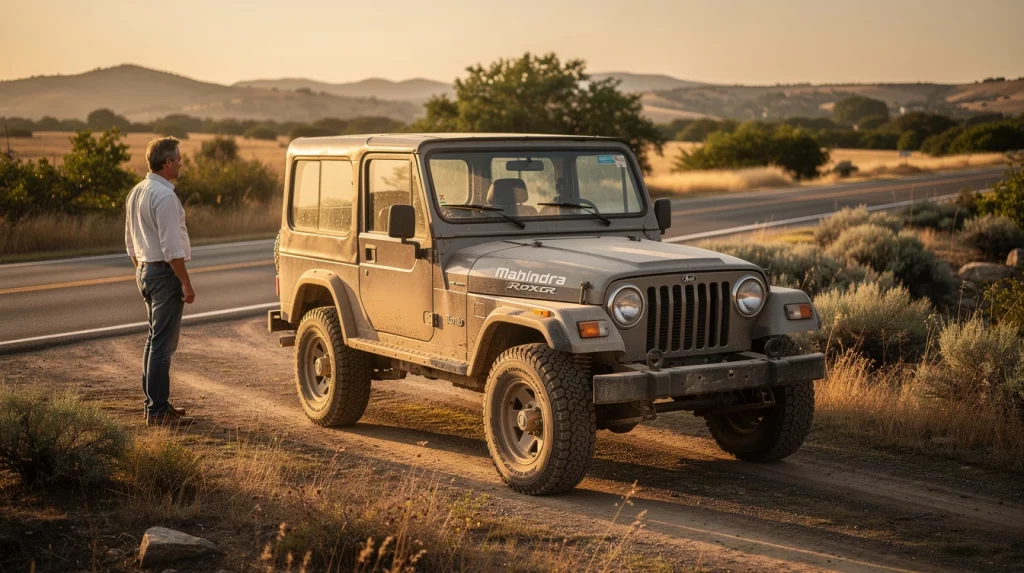
Can you drive a Mahindra Roxor on the street? Short answer: not by default, and not in most states without some serious paperwork. The Roxor is built as an off-highway vehicle, and Mahindra designed it that way intentionally. But that doesn’t mean your options are zero.
This guide covers exactly why the Roxor isn’t street-legal from the factory, what states allow (or don’t allow), the registration path most owners are taking, and what Dirt Legal can do to help you get your Roxor properly titled and registered without the headaches.
By the end, you’ll know what’s actually possible, what the rules are in your state, and how to move forward with confidence.
Why the Mahindra Roxor Is Not Street-Legal From the Factory
The Roxor is classified by Mahindra as an off-highway vehicle (OHV), not a motor vehicle under federal law. That classification is intentional. It’s how Mahindra is able to sell a vehicle with a diesel engine, a solid front axle, and a Jeep-like body style without running into significant federal motor vehicle safety standards (FMVSS) compliance issues.
Because the Roxor doesn’t meet FMVSS requirements, it can’t receive a Certificate of Origin as a road vehicle. That means no manufacturer’s title. No title means no standard registration path. No standard registration means you can’t put a plate on it and legally drive it home from the dealership.
What Does “Off-Highway Vehicle” Actually Mean for Registration?
An OHV classification means the vehicle is sold for use on private property, trails, farms, and off-road courses. It’s not the same as a UTV or ATV in every state’s eyes, which adds another layer of confusion. Some states have clear OHV titling programs. Others don’t cover the Roxor’s vehicle type at all.
The practical result is that your Roxor may be difficult to title in your home state, especially if you live somewhere without a formal OHV title pathway. That’s exactly why many owners look at alternative registration strategies.
The FMVSS Problem Explained Simply
Federal Motor Vehicle Safety Standards cover things like lighting, mirrors, brake performance, seat belts, and crash protection. The Roxor, as manufactured, doesn’t meet all of those standards. Even if you bolt on extra lights and mirrors, the manufacturer’s classification still governs what a state can issue a title for. You can’t just add equipment and call it fixed.
Some states allow exemptions for low-speed or off-highway vehicles on certain road types. That’s where the picture starts to get more interesting.
State-by-State: Where Can You Drive a Roxor on Public Roads?
The rules vary a lot. A handful of states have created pathways specifically for off-highway vehicles on public roads, usually with speed and road-type restrictions. Others treat the Roxor the same as any UTV. And some states simply have no workable pathway at all.
Ready to register your vehicle?
Join thousands of vehicle owners who use Dirt Legal to handle their registration quickly and hassle-free.
Register Your Vehicle Today → →States With More Flexible OHV Road Access
States like Utah, Montana, Idaho, and parts of the rural West have historically been more permissive about OHV use on certain public roads, especially low-speed county roads. Montana in particular has a vehicle registration framework that’s worth understanding. If you can title the Roxor, you can potentially register it, and Montana’s registration rules are more accessible than most states.
South Dakota is another state with a practical approach to OHV and UTV registration. The South Dakota Division of Motor Vehicles has provisions for off-road vehicles that may apply depending on how your Roxor is classified.
For a similar situation with side-by-sides and UTVs across different states, check out Can You Make a UTV Street Legal in Montana? What You Need to Know, which covers the registration and titling framework that applies to many OHVs in the state.
States Where It’s Much Harder
California, for example, is notoriously strict. Even if you want to register a Roxor for off-highway use only, the California DMV has specific requirements that are tough to meet for vehicles that lack a standard title. If you’re in a high-regulation state, the Montana LLC registration route is one of the most common solutions.
If you want to see how these issues play out in other states with UTVs, Can You Make a UTV Street Legal in California? is a useful comparison.
What About Farm and Agricultural Exemptions?
Some states allow OHVs to travel short distances on public roads when used for agricultural purposes. If you’re using your Roxor on a farm or ranch, your state may have a farm vehicle exemption that lets you cross roads or drive short distances without full street-legal registration. Check your state DMV directly for the specifics, since these exemptions are narrow and vary widely.
The Montana LLC Registration Route for Roxor Owners
Here’s where things get genuinely useful. Montana has no sales tax. No emissions testing. No annual inspections. And critically, Montana’s registration framework is accessible to non-residents through a Montana LLC.
Owners across the country, especially those in high-tax or high-restriction states, have been using Montana LLC vehicle registration for years to title and register vehicles that are difficult to handle in their home state. The Roxor fits this pattern well.
How Montana LLC Registration Works for the Roxor
For many Roxor owners, Montana LLC registration has become one of the easiest ways to simplify the registration process while securing a clean title and valid plates. The setup is straightforward: you form a Montana LLC, then title and register the Roxor under that LLC.
One of the biggest advantages is cost savings. Montana has no sales tax, which means many buyers avoid paying sales tax on the vehicle purchase entirely. Registration fees are also among the most affordable in the country, making Montana an attractive option for Roxor owners looking for a smoother path to ownership documentation and registration.
Best of all, the process can be handled remotely. You don’t need to travel to Montana or spend weeks navigating complicated DMV paperwork on your own. Dirt Legal handles the entire process from start to finish, helping owners avoid delays, confusion, and unnecessary stress.
That convenience is exactly why so many Roxor owners choose Dirt Legal.
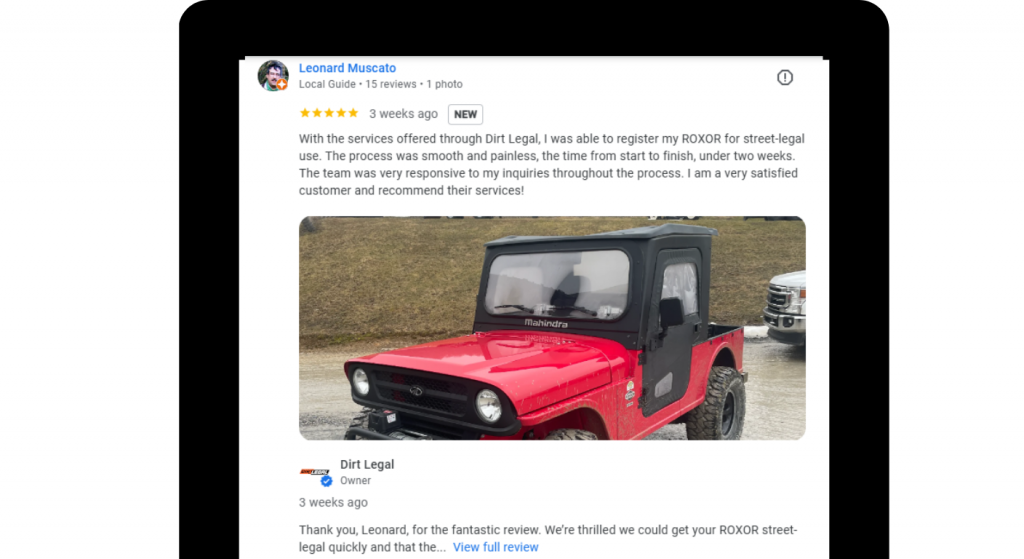
“With the services offered through Dirt Legal, I was able to register my ROXOR for street-ready use. The process was smooth and painless, with everything completed in under two weeks. The team was very responsive throughout the process. I’m a very satisfied customer and highly recommend their services!”
Stories like this highlight what matters most to Roxor owners: getting their paperwork completed quickly, correctly, and hassle-free.
It’s also important to understand what Montana registration helps accomplish. A clean title and registration can help support insurance options, financing opportunities, resale value, and additional road-use pathways depending on your state’s requirements.
Road access itself still depends on your state’s equipment and operation requirements, but having proper paperwork in place creates a much stronger foundation for ownership and long-term flexibility.
For many Roxor owners, that peace of mind alone makes the process worth it.
For a broader look at how vehicle registration requirements vary nationwide, check out Navigating Vehicle Registration Laws and Car Registration Requirements.
Titling a Roxor When You Have No Manufacturer’s Title
Because the Roxor doesn’t come with a traditional MSO (Manufacturer’s Statement of Origin) for road use, getting a title can feel like hitting a wall. Mahindra provides a “certificate of origin,” but it’s for an off-highway vehicle, not a road vehicle. That’s a meaningful difference in how states process it.
Bonded Titles and Alternative Title Paths
If you purchased a Roxor used and the seller didn’t transfer any paperwork, or if the paperwork you have doesn’t satisfy your state’s DMV, a bonded title may be an option. A bonded title is a real, state-issued title, backed by a surety bond, that establishes your ownership when standard documentation isn’t available.
Dirt Legal helps owners work through these title situations regularly. If you’ve hit a wall trying to get your Roxor titled, this is a common path forward. For a parallel situation with motorcycles, Have a Motorcycle With No Title? Here’s How to Get One shows how the process works in practice.
What You Need to Start the Title Process
At minimum, you’ll typically need proof of purchase, the Mahindra certificate of origin or bill of sale, and a VIN. The Roxor does have a VIN, which is important for any title or registration process. If there’s any question about your vehicle’s history, running a quick VIN check is a smart first step before submitting paperwork.
| Registration Option | Best For | Sales Tax | Emissions Required | Difficulty |
|---|---|---|---|---|
| Home State OHV Title | States with clear OHV programs | Varies | Varies | Medium to High |
| Montana LLC Registration | All states, especially high-tax states | None | None | Low (with help) |
| South Dakota Registration | Owners establishing SD residency | Low | None | Low to Medium |
| Bonded Title (Home State) | Missing title situations | Varies | Varies | Medium |
| Farm/Agricultural Exemption | Agricultural use only | N/A | None | Low (if eligible) |
Street-Legal Conversions: What’s Possible for the Roxor?
Some Roxor owners go further than just getting a title. They want to actually drive on public roads, and a few states do allow that with the right modifications. A street-legal conversion means adding the equipment required by your state to use the vehicle on specific road types.
Typical Equipment Required for Street Use
Most states that allow OHV road use require a minimum set of equipment. This typically includes headlights, tail lights, brake lights, turn signals, a horn, mirrors, a windshield (or eye protection), seat belts, and a DOT-compliant speedometer. The Roxor comes with some of these from the factory. Others you’ll need to add.
The equipment list varies by state. Before spending money on modifications, check your state’s specific OHV road-use statute. Some states have additional requirements like a slow-moving vehicle emblem or specific tire ratings.
Speed and Road-Type Restrictions
Even in permissive states, OHV road use is typically restricted to roads with speed limits of 35 mph or less, or to unpaved county roads. Highway use is almost never allowed. If you’re thinking about the Roxor as a primary road vehicle, it’s not going to work for most commutes. For farm-to-field travel, rural errands, or off-road-adjacent use, it can work well in the right state.
For a look at how similar restrictions apply to other off-road vehicles, Can You Make a UTV Street Legal in South Dakota? is a helpful read, as South Dakota has one of the more accessible OHV road frameworks in the country.
Insurance for a Street-Used Roxor
If you plan to use your Roxor on public roads in any capacity, you’ll need insurance. Most standard auto insurance policies won’t cover an OHV. You’ll need a specialty off-road or powersport policy that also covers limited road use. Make sure any policy you get matches the registration type on your Roxor. A vehicle registered as an OHV under a Montana LLC, for example, may require a specific type of policy. Talk to your insurer before assuming coverage applies.
Frequently Asked Questions About Driving a Mahindra Roxor on the Street
Is the Mahindra Roxor street-legal in any state?
Not from the factory, no. The Roxor is sold as an off-highway vehicle and doesn’t meet federal motor vehicle safety standards for standard road use. However, some states with OHV road-use provisions may allow the Roxor on certain low-speed public roads after modifications. States like Utah, Montana, and South Dakota have more flexible frameworks than high-regulation states like California. Always check your specific state’s OHV road statute before assuming road access is permitted.
Can I get a title for a Mahindra Roxor?
Yes, but the path depends on your state and your paperwork situation. Montana LLC registration is a popular route because it doesn’t require emissions testing or inspections and the state has no sales tax. If you purchased a used Roxor with incomplete paperwork, a bonded title may be the right path. Dirt Legal handles both scenarios regularly. The key is having a valid VIN and some form of proof of purchase to start the process.
How much does it cost to register a Roxor through a Montana LLC?
Montana’s registration fees are among the lowest in the country. The official Montana fee schedule shows that registration costs vary by vehicle age and weight, but are typically a few hundred dollars or less for a vehicle like the Roxor. Add the cost of LLC formation and Dirt Legal’s service fee, and the total is still often less than what you’d pay in sales tax alone in a high-tax state. Vehicle registration costs in states like California or Texas can run into thousands when sales tax is included.
Does a Montana LLC registration make my Roxor street-legal in my home state?
No. Montana registration gives you a valid title and plate, but it doesn’t change your home state’s rules about what vehicles can use public roads. You’ll still need to comply with your home state’s OHV road-use laws. That said, having a proper title is the first step for anything, including insurance, resale, and applying for road-use permits where available. Think of Montana registration as solving the paperwork problem, not the road-access problem.
What if I bought a used Roxor with no title?
That’s a common situation. The Roxor’s off-highway classification means paperwork sometimes gets lost or never transferred properly between owners. Options include pursuing a bonded title in your home state, or working through a Montana LLC registration using the bill of sale and Mahindra certificate of origin. Dirt Legal can assess your specific paperwork situation and recommend the right path. For a parallel example with motorcycles, Have a Motorcycle With No Title? Here’s How to Get One walks through how the process typically works.
Can I register my Roxor in South Dakota if I don’t live there?
South Dakota registration is typically tied to residency or a business presence in the state. It’s a viable option for people who establish South Dakota residency, which some full-time travelers and remote workers do intentionally for its low fees and simple process. If you’re not a South Dakota resident and don’t plan to become one, Montana LLC registration is usually the more practical route for out-of-state owners. The South Dakota Division of Motor Vehicles has more details on eligibility for non-residents.
Are there other off-road vehicles with similar street-legal questions?
Absolutely. The Roxor sits in the same general category as side-by-sides, UTVs, and some larger ATVs when it comes to street-legal questions. The rules vary significantly by vehicle type and state. If you own or are considering other off-road vehicles, posts like Can You Make a UTV Street Legal in South Dakota? and Can You Make a UTV Street Legal in Montana? cover the frameworks that apply most broadly to OHV owners nationwide.
Getting Your Roxor Titled and Registered the Right Way
The bottom line on driving a Mahindra Roxor on the street is this: the factory won’t do it for you, and most states won’t make it easy. But that doesn’t mean you’re stuck with an untitled, uninsured vehicle sitting in your garage.
Montana LLC registration is the most widely used solution for Roxor owners across the country. It gives you a real title, a real plate, no sales tax, and no emissions headaches. South Dakota is another strong option for those with ties to the state. And for owners with title gaps, bonded title services fill in what standard paperwork can’t.
Dirt Legal has helped thousands of OHV, UTV, and off-road vehicle owners work through exactly these situations. The process is straightforward when you know the right steps, and we handle the DMV so you don’t have to. Ready to get your Roxor titled and registered properly? See what Dirt Legal’s services actually cover before you start.