Motorcycles have two separate brakes, front and rear, because each wheel requires independent braking force to stay stable under deceleration. Unlike a car, a motorcycle’s physics demand precise control over weight transfer, and a single combined system would make that impossible for most riding situations.
Why Can’t a Motorcycle Just Use One Brake Like a Car?
Cars distribute braking force across four contact points with sophisticated ABS and electronic distribution systems. A motorcycle has only two wheels, and the front wheel handles roughly 70, 80% of stopping power during hard braking. Coupling both wheels to a single lever would either under-brake the front or lock the rear, both dangerous outcomes.
- Weight transfer: Braking shifts mass forward onto the front wheel, increasing its grip while unloading the rear.
- Rear lockup risk: A locked rear wheel causes a skid or highside; the rider needs independent control to release it instantly.
- Front lockup risk: Too much front brake too fast causes a tuck and fall, especially mid-corner.
- Balance: Riders actively modulate each brake to keep the bike upright and pointed straight.
What Does the Front Brake Actually Do on a Motorcycle?
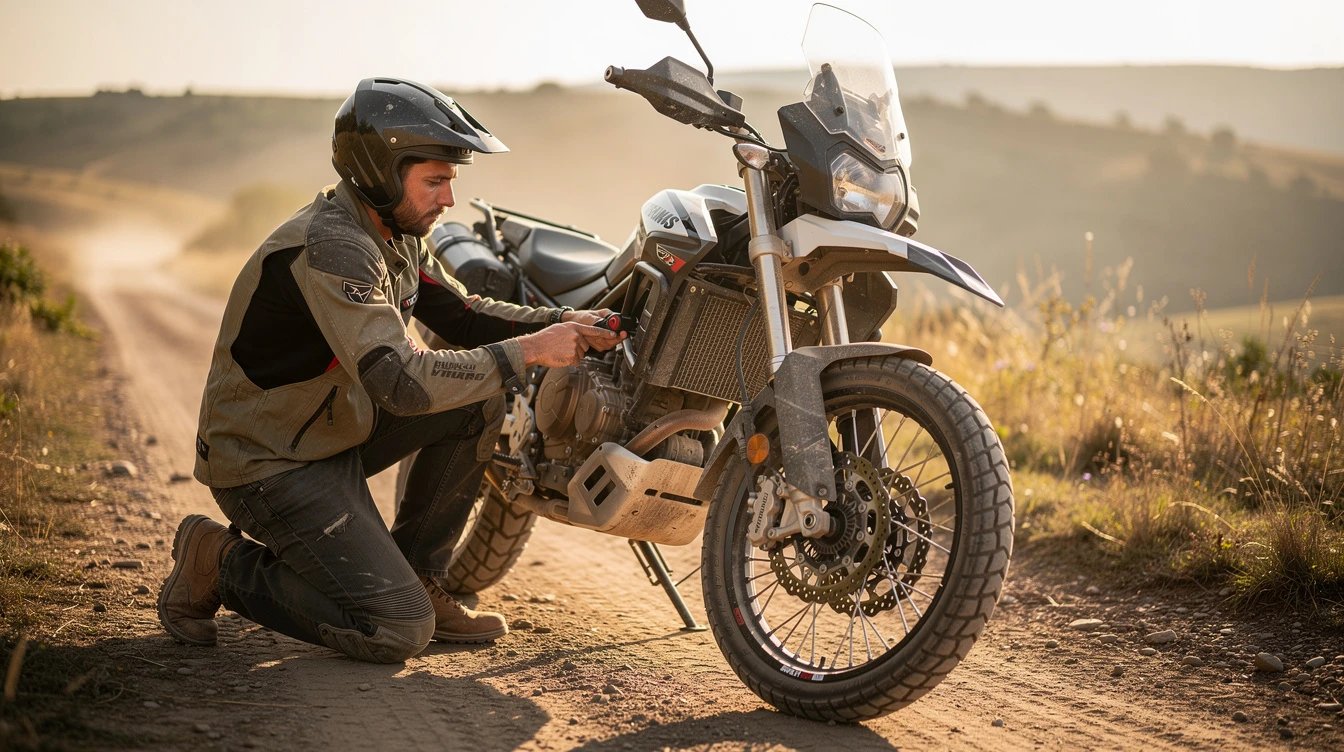
The front brake is the primary stopping force on any motorcycle. Operated by the right hand lever, it engages the front disc or drum and can generate most of the bike’s total deceleration on its own during emergency stops.
Ready to register your vehicle?
Join thousands of vehicle owners who use Dirt Legal to handle their registration quickly and hassle-free.
Register Your Vehicle Today → →- Right-hand lever on the handlebar.
- Controls one or two front discs depending on the bike.
- Responsible for up to 80% of stopping power in a straight-line stop.
- Requires progressive squeeze, not a sudden grab, to avoid front-wheel lockup.
New riders often under-use the front brake out of fear. That instinct costs stopping distance. Controlled, progressive front brake application is the foundation of safe riding.
What Does the Rear Brake Do and When Should You Use It?
The rear brake, operated by the right foot pedal, adds stability and fine control. It’s especially useful at low speeds, during cornering, and when trail-braking into turns.
- Low-speed maneuvers: Dragging the rear brake while using throttle gives precise speed control in tight turns or parking lots.
- Emergency stops: Combined with front braking, the rear adds total stopping power without destabilizing the chassis.
- Trail braking: Carrying light rear brake into a corner helps settle suspension and maintain balance.
- Downhill riding: Rear brake prevents the bike from pitching forward on steep descents.
Honest truth: many experienced riders use the rear brake sparingly on the road but rely on it constantly for track work and off-road riding. Context matters.
Do Any Motorcycles Combine Both Brakes Like a Car?
Yes. Combined Braking Systems (CBS) and Linked Braking Systems (LBS) apply both brakes when you activate one lever. Honda pioneered this on scooters and some touring bikes. Modern ABS systems also coordinate front and rear electronically.
| System Type | How It Works | Common On | Rider Control |
|---|---|---|---|
| Independent (standard) | Front and rear fully separate | Sport bikes, cruisers, dirt bikes | Full independent control |
| Combined Braking (CBS) | One lever activates both wheels proportionally | Scooters, commuter bikes | Reduced, partially linked |
| Linked Braking (LBS) | Mechanically or hydraulically links front and rear | Honda Gold Wing, touring bikes | Partially linked |
| ABS (Electronic) | Prevents lockup on either wheel automatically | Most modern bikes | Full control, ABS prevents lockup |
The takeaway: combined systems work well for casual riding but reduce the precision that experienced riders want in sport or off-road use. Most street-legal motorcycles sold today include ABS as standard.
For riders thinking about registration, check out the Montana Plates: Your Complete Guide to Options, Costs, and Registration for a breakdown of how motorcycle plate options work in Montana.
How Does Motorcycle Braking Compare to Car Braking?
Cars use a single pedal connected to a hydraulic system that distributes braking force across all four wheels. Electronic brake-force distribution (EBD) and ABS handle the balance automatically. Motorcycles can’t rely on electronics alone because rider body position and road feel change the equation constantly.
- Cars: One pedal, four-wheel distribution, electronics do the proportioning.
- Motorcycles: Two controls, two wheels, rider does the proportioning.
- Stopping distance: A well-ridden motorcycle stops comparably to a car, but technique matters far more.
- Consequence of error: A braking mistake in a car is recoverable. On a motorcycle, it can mean a fall.
This is exactly why motorcycle training courses spend so much time on brake modulation. The skill gap between a new rider and an experienced one shows up most clearly in emergency stops.
Curious about what it takes to ride street-legal? The guide on Are Pit Bikes Street Legal? covers what requirements apply to smaller bikes and how registration factors in.
If you own a motorcycle and want to understand how LLC-based registration can work for you, the The Complete Guide to Forming a Montana LLC for Vehicle Registration explains the full process. Riders who use a Montana LLC for vehicle registration often do so to avoid sales tax on higher-value bikes. Does Montana Have Sales Tax on Vehicles? breaks down exactly what that means for motorcycle buyers.
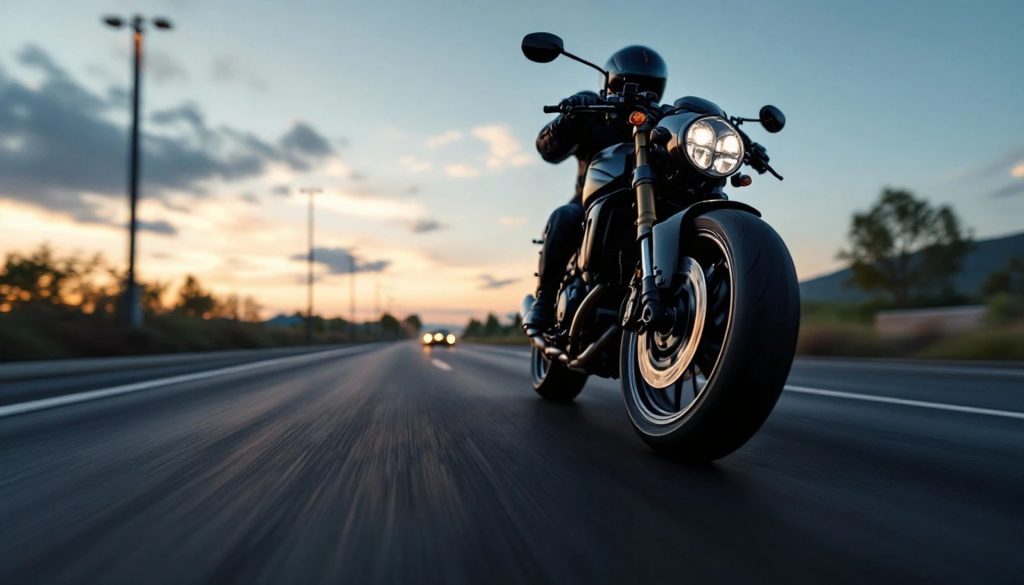
What Should New Riders Know About Using Both Brakes?
Most new riders default to rear-brake-only braking because it feels safer. It isn’t. Here’s the correct approach for building good brake habits:
- Cover the front brake always, rest two fingers on the lever so you can react instantly.
- Apply front brake first, progressively, squeeze firmly and smoothly, never grab.
- Add rear brake simultaneously, moderate pressure to supplement front braking.
- Keep the bike upright while braking, most hard braking should happen before corner entry.
- Practice emergency stops, in an empty lot, repeatedly, until the muscle memory is automatic.
Dirt Legal has helped 80,000+ vehicle orders to date, many of them motorcycles and powersports. The most frequent reason documents come back for correction in our process is odometer compliance, so double-check your paperwork before submitting (internal data, rolling last 90 days, n=115).
For more on what documentation you need to keep your motorcycle properly titled, see What Is the Best Proof of Vehicle Ownership?.
Frequently Asked Questions
Why do motorcycles have a hand brake and a foot brake?
The hand lever controls the front brake and the foot pedal controls the rear brake, keeping each wheel’s braking force independent. This split design lets riders modulate stopping power precisely based on speed, road surface, and whether they’re in a straight line or mid-corner. It’s a deliberate ergonomic and safety choice, not a limitation.
Is it bad to only use the rear brake on a motorcycle?
Yes. Relying only on the rear brake dramatically increases stopping distance and raises the risk of rear-wheel lockup. The front brake provides most of the stopping force. Using only the rear is a common beginner habit that advanced rider training courses specifically correct. Always use both brakes together for most stops.
Do motorcycles with ABS still have two separate brakes?
Yes. ABS prevents wheel lockup but doesn’t combine the controls. You still operate front and rear brakes independently. ABS simply intervenes electronically if a wheel is about to lock, pulsing brake pressure faster than any rider can. The physical controls, one lever, one pedal, stay the same.
Can you register a motorcycle in Montana without living there?
Yes. Non-residents can register their vehicle through a Montana LLC without establishing residency. Montana has no sales tax and no emissions testing requirements. Dirt Legal assists with the paperwork remotely. See the full walkthrough in How to Register a Car in Montana Without Living There.
What are Montana motorcycle license plates and how do I get them?
Montana motorcycle license plates are issued through the Montana Motor Vehicle Division after completing registration. Non-residents can obtain them by forming a Montana LLC and registering the bike through that entity. Dirt Legal manages the required filings for your Montana LLC. The full details are in our Montana Plates complete guide.
Does Montana have state sales tax on motorcycle purchases?
No. Montana has no state sales tax on vehicles, including motorcycles. This is confirmed by the Montana Department of Revenue. Buyers who purchase high-value motorcycles and register through a Montana LLC can avoid sales tax that other states charge, sometimes saving thousands of dollars.
Ready to get your motorcycle registered the smarter way? Dirt Legal provides remote paperwork support for motorcycle registration, Montana LLC formation, and title assistance.
Start Your Registration Today →