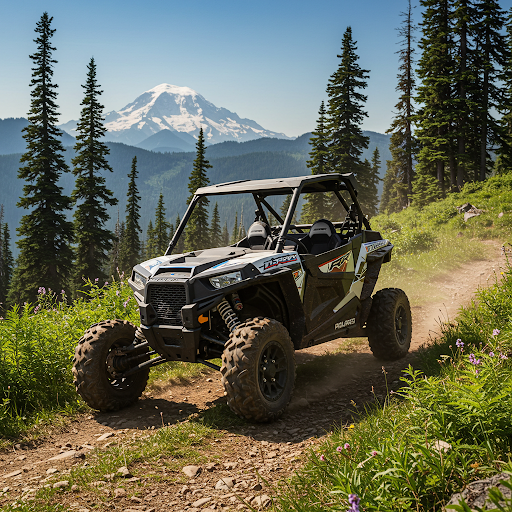
Washington allows certain off-road vehicles, including UTVs, to be used on public roads under specific conditions. However, not all roads are open to UTVs, and not all UTVs qualify. You must meet the standards in RCW 46.09 and WAC 308-94-030 to operate a UTV on-road.
Understanding Vehicle Classification
In Washington, UTVs that are modified for street use are classified as Wheeled All-Terrain Vehicles (WATVs). They are defined under RCW 46.09.310 and can be operated on public roads only if they meet the requirements of RCW 46.09.457 and the local jurisdiction allows it.
There are two primary types of WATV registration:
- Off-road use only
- On-road and off-road use
To qualify for the latter, your vehicle must be equipped to meet street-legal standards and be operated only on approved roads.
Required Modifications for Street Legality
Under RCW 46.09.457, a UTV must be equipped with the following to be considered for on-road use in Washington:
- Headlights (must be capable of both high and low beam operation)
- Tail lights
- Brake lights
- Turn signals (front and rear)
- One or more rearview mirrors (RCW requires at least a left side mirror and either a right side mirror or center mirror)
- Horn (audible from a distance of at least 200 feet)
- Reflectors (at least one red reflector on each side at the rear)
- Windshield (made of safety glass, or alternatively, the operator and any passengers must wear Department of Transportation-compliant eye protection)
- Speedometer
- Muffler (must include a U.S. Forest Service-approved spark arrestor and meet local sound ordinance requirements)
- Tires (DOT-approved for highway use)
- License plate bracket with plate light
- Seat belts for each passenger seat (mandatory under RCW 46.37.510 and RCW 46.37.515)
This is a mandatory equipment list. If your UTV lacks any of the above features, it cannot legally qualify for on-road operation under Washington state law.
Inspection and Certification
Some counties may require an inspection of the vehicle before issuing an on-road WATV decal. The inspection verifies that all required equipment is installed and functional. This may be performed at a vehicle licensing office or by a law enforcement officer in certain counties.
The inspection is not always enforced uniformly across Washington—some rural counties may have fewer formal requirements, while urban counties may be stricter.
Register as a WATV
Once the UTV is properly equipped, you’ll need to:
- Apply for a Washington title (using the Manufacturer’s Certificate of Origin or an out-of-state title)
- Complete a WATV Affidavit indicating you’ve met the equipment requirements (as per RCW 46.09.457)
- Register the vehicle with the Department of Licensing for on-road use
- Receive:
- A metal license plate
- A WATV on-road use decal
- A metal license plate
This process is outlined in RCW 46.09.442, which governs the titling and registration of WATVs for dual use.
Know Where You Can Drive
Not every road in Washington is open to UTVs—even with an on-road decal. Per RCW 46.09.455, UTVs can only operate on roads with a posted speed limit of 35 mph or less, and only if the city or county has passed an ordinance allowing it.
Counties that generally allow UTVs on designated roads include:
- Okanogan County
- Grant County
- Ferry County
- Stevens County
- Asotin County
- Kittitas County
Urban counties such as King, Pierce, Snohomish, and Spokane do not allow on-road UTV use on public roads.
Additionally, RCW 46.09.470 prohibits UTV operation:
- On interstates or limited access highways
- In jurisdictions that have not opted in
- On roads exceeding the 35 mph limit, regardless of actual speed traveled
Even if your UTV is fully street-legal, it must stay off major highways and freeways.
Insurance and Additional Considerations
While RCW 46.09 does not specifically mandate insurance for WATVs, liability insurance is required for most on-road vehicles under RCW 46.30.020. To avoid fines or complications, it’s highly recommended to carry an insurance policy that meets Washington’s minimum liability requirements if you’re operating a UTV on public roads.
You may also need to:
- Obtain an off-highway vehicle permit if using trails
- Re-title your vehicle if converting from an out-of-state off-road registration
Got it—here’s the same section, but without any bold formatting:
Off-Road Use Only Registration
If your UTV will be used strictly on private property, trails, or OHV-designated areas, it needs to be registered as an off-road vehicle (ORV). You’ll receive an ORV decal, which must be displayed on the vehicle.
To register for off-road use only:
- Submit a completed title application (Form TD-420-001) to a licensing office
- Provide the Manufacturer’s Certificate of Origin (MCO) or out-of-state title
- Pay the applicable title and ORV registration fees
- You’ll receive:
- A Washington ORV permit decal
- A Washington ORV registration certificate
- A Washington ORV permit decal
This does not allow any on-road use unless it’s in transit across a road that intersects a trail, and even then, rules vary by jurisdiction.
On-Road and Off-Road (Dual-Use) Registration
To legally drive a UTV on public roads in Washington, you must apply for on-road use registration as a Wheeled All-Terrain Vehicle (WATV). This requires both a title and specific declarations that your vehicle has been equipped to meet on-road standards.
Here’s what you’ll need:
- Completed title application
- Use the same TD-420-001 form
- If coming from out-of-state, include your prior registration/title
- Use the same TD-420-001 form
- WATV Affidavit (Form TD-420-377)
- You must declare under penalty of perjury that the UTV meets all required on-road equipment standards outlined in RCW 46.09.457
- You must declare under penalty of perjury that the UTV meets all required on-road equipment standards outlined in RCW 46.09.457
- Vehicle Inspection (if required by your county)
- Some counties may require an in-person equipment inspection by a licensing agent or local law enforcement before approving the on-road endorsement
- Some counties may require an in-person equipment inspection by a licensing agent or local law enforcement before approving the on-road endorsement
- Payment of fees
- Includes standard titling, plate issuance, and WATV decal fees
- County taxes and filing fees vary
- Includes standard titling, plate issuance, and WATV decal fees
Upon approval, you will receive:
- A metal license plate (for road use)
- A WATV on-road use decal
- A registration certificate showing both on- and off-road use
Retitling an Out-of-State UTV in Washington
If you’re bringing a UTV into Washington from another state:
- You’ll need to surrender the out-of-state title and registration
- Submit a Vehicle/Vessel Bill of Sale (Form TD-420-065) or similar ownership proof
- Provide an odometer disclosure if applicable (for newer UTVs)
- If the UTV was previously titled as off-road only, you’ll still need to equip it and follow the full WATV registration process to receive an on-road endorsement
Fees
While fees vary by location, here are common cost estimates:
- Title application: ~$15
- Plate fee: ~$15–$25
- WATV decal: ~$18
- Filing fees and sales tax: Vary by county and vehicle value
If you purchased the vehicle new or from a dealer, Washington use tax will likely be assessed based on the purchase price.
Summary of Relevant Codes
Here are the codes that govern UTV street legality in Washington:
- RCW 46.09.310 – Definitions of WATVs
- RCW 46.09.442 – WATV registration and titling process
- RCW 46.09.455 – Local government authority to designate public roads
- RCW 46.09.457 – Required equipment for on-road use
- RCW 46.09.470 – Prohibited areas of operation
- WAC 308-94-030 – On-road use endorsement and procedures
- RCW 46.37.510 and RCW 46.37.515 – Seat belt and safety restraint laws
RCW 46.30.020 – Insurance requirements