
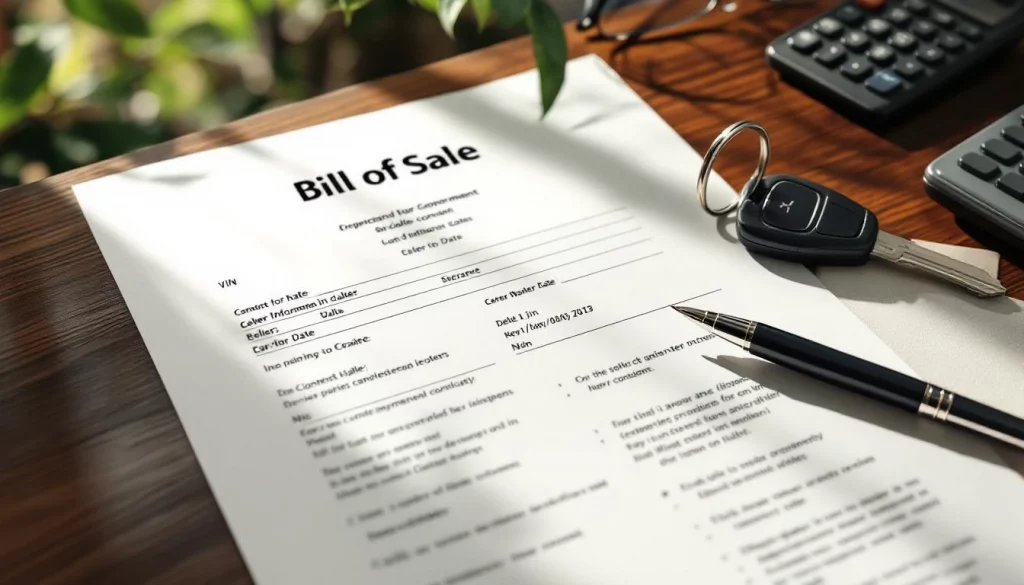
A bill of sale for a car is one of the most important documents in any private vehicle transaction, yet most people only think about it at the last second. Get it wrong, and you could end up with a registration problem, a tax dispute, or worse, no official proof you ever owned the vehicle. This guide covers everything, from what a bill of sale actually does to what happens after you sign one.
You’ll learn exactly what information belongs on the document, when states require it, how it connects to the title transfer process, and what to do if you bought a vehicle without a clean title to go with it.
Let’s get into it.
What Is a Bill of Sale for a Car?
A bill of sale is a written record proving that ownership of a vehicle changed hands between a seller and a buyer on a specific date for a specific price. Think of it as a receipt for a major purchase, but with weight behind it.
For automobiles, the document typically does three things. It records the details of the transaction, it establishes the purchase price (which matters for sales tax calculations), and it serves as proof of ownership in situations where a title isn’t immediately available.
Is a Bill of Sale the Same as a Title?
No. A title is a government-issued certificate of ownership, while a bill of sale is a private agreement between two parties. You need both to complete most title transfers at the DMV. The bill of sale supports the title transfer, but it doesn’t replace the title.
If you bought a vehicle with no title, a bill of sale alone won’t be enough to register it in most states. Check out our guide on Should You Buy a Car Without a Title? What to Know Before Buying a Car Without a Title for a full breakdown of your options when title paperwork is missing.
When Do You Actually Need One?
You need a bill of sale for a car in almost every private party sale. Dealerships generate their own paperwork, but when you buy from an individual, this document is often the only written record of the deal. Many states require a bill of sale to process a title transfer, and some require it specifically to calculate sales or excise taxes on the transaction.
What Must a Bill of Sale Include?
The exact requirements vary by state, but a complete bill of sale for any automotive transaction should include all of the following details. Missing even one can cause delays at the DMV or create disputes down the road.
Ready to register your vehicle?
Join thousands of vehicle owners who use Dirt Legal to handle their registration quickly and hassle-free.
Register Your Vehicle Today → →Required Vehicle Information
- Vehicle Identification Number (VIN)
- Year, make, model, and body style
- Current odometer reading
- Vehicle color
- License plate number (if applicable)
The VIN is especially critical. It ties the document to a specific vehicle, not just a description of one. If you’re ever uncertain about VIN accuracy or want to check the vehicle history before signing, a quick VIN inspection can save you from major headaches. The NHTSA VIN decoder is a free tool that lets you verify a vehicle VIN against federal records and check for open recalls. For a more complete vehicle history and registration overview, visit the Dirt Legal VIN report page.
Also check our post on How to Spot a Fake Vehicle VIN Check: Protect Your Investment explains what to watch for when reviewing vehicle identification numbers.
Required Transaction Information
- Full name and address of buyer and seller
- Sale price in dollars (or “gift” if applicable)
- Date of the transaction
- Payment method (cash, check, etc.)
- Signatures of both parties
- Notarization (required in some states)
Some states, like Wisconsin, have official bill of sale forms you can download directly from their DMV website. Others accept any written document that contains the required fields. Always check your state’s requirements before the sale closes.
How a Bill of Sale Connects to the Title Transfer Process
Once money changes hands and both parties sign the bill of sale, the buyer typically has a limited window to complete the title transfer at their state DMV. Missing that deadline usually means late fees, and in some states, penalties.
The bill of sale supports the DMV title transfer by confirming the sale price (used for tax assessment), documenting the odometer reading (required under federal law for most vehicles under 10 years old), and verifying the seller’s identity.
The Role of Odometer Disclosure
Federal law requires an odometer disclosure on vehicle sales for most cars under 10 years old. Many states incorporate this directly into the bill of sale form. If the odometer has been replaced or is inaccurate, that has to be noted. Skipping this step is a federal violation, not just a paperwork error.
What About Out-of-State Purchases?
Buying a vehicle from another state adds a layer of complexity. You’ll use the bill of sale to prove the purchase price to your home state DMV, which will then assess sales tax or excise fees accordingly. Rules differ widely, so it’s worth understanding what you’re walking into. Our post on The 5 Biggest Out-of-State Registration Mistakes (And How to Avoid Them) covers the most common problems buyers run into when crossing state lines.
For buyers who want to avoid high registration fees or sales tax on a qualifying vehicle, registering through a Montana LLC is worth understanding. Montana has no sales tax on vehicle purchases, which is a meaningful saving on high-value vehicles.
Montana and South Dakota: What You Should Know
Montana and South Dakota are two states that regularly come up in conversations about vehicle registration, and for good reason. Each offers distinct advantages that buyers across the country take advantage of.
Does Montana Have State Sales Tax?
No. Montana has no state sales tax, including on vehicle purchases. That’s confirmed by the Montana Department of Revenue. When you register a vehicle through a properly formed Montana LLC, you typically avoid the sales tax you’d pay in your home state. This is completely above board and widely used for high-value vehicles, RVs, motorcycles, and collector cars.
The Hidden Perks of a Montana License Plate: A Tax-Saving Edge post breaks down exactly how Montana plates work and why so many owners pursue this option.
South Dakota Registration Basics
South Dakota offers low registration fees and a straightforward titling process. It’s a popular choice for people who want clean, simple registration without high annual costs. The South Dakota Division of Motor Vehicles handles all vehicle title and registration services for the state.
For a full comparison of how Montana and South Dakota registration options work, and which might fit your situation, see how the process works on our site.
Bill of Sale for Motorcycles and Powersports Vehicles
The same principles that apply to cars carry over to motorcycles, ATVs, UTVs, and other powersport vehicles. A bill of sale for a motorcycle transaction should include the same core fields: VIN, make, model, year, odometer, sale price, buyer and seller information, and signatures.
Why Motorcycle Titles Are Often Messier
Motorcycles and powersport vehicles are bought and sold informally more often than cars. That means titles go missing, lien releases get skipped, and odometer statements are overlooked. A solid bill of sale at the time of purchase gives you something to work with if the title situation turns out to be complicated later.
If you’ve already purchased a motorcycle and the title situation is a mess, start with our guide on Have a Motorcycle With No Title? Here’s How to Get One. It walks through your options in plain language.
Powersport and Off-Road Vehicles
For UTVs and off-road vehicles that owners may want to make street-legal, the bill of sale is just the beginning of the paperwork. Registration requirements vary significantly by state. A few useful starting points depending on where you ride: Can You Make a UTV Street-Legal in Montana? and Can You Make a UTV Street Legal in South Dakota?.
Bill of Sale Summary Table: What to Include
| Field | Required in Most States? | Notes |
|---|---|---|
| Vehicle VIN | Yes | 17-character identifier, verify against title |
| Year / Make / Model | Yes | Must match title exactly |
| Odometer Reading | Yes (federally required) | Required for vehicles under 10 years old |
| Sale Price | Yes | Used for tax calculation at DMV |
| Buyer Full Name and Address | Yes | Must match government-issued ID |
| Seller Full Name and Address | Yes | Must match title and government-issued ID |
| Date of Sale | Yes | Starts the title transfer deadline clock |
| Both Signatures | Yes | Some states also require notarization |
| Notarization | Varies by state | Required in some states, optional elsewhere |
| Payment Method | Optional | Useful for dispute resolution |
| “As-Is” Disclosure | Optional | Protects seller from warranty claims |

Frequently Asked Questions About Bill of Sale Car Documents
Do I need a bill of sale if I already have the title?
Yes, in most cases. Even with a signed title in hand, many states require a separate bill of sale to process the registration and calculate the correct taxes. The title proves ownership, but the bill of sale establishes the terms of the transaction. Some states specifically need the documented sale price to assess excise or sales tax at the DMV window. It’s a short document, so there’s no good reason to skip it.
Can I write my own bill of sale, or do I need an official form?
You can write your own in most states, as long as it contains all required fields. Some states, like Wisconsin, have official DMV-issued forms that are preferred or required. Check your state’s DMV website before drafting your own. If you’re in a state with an official form, use it, since it’s designed to meet all local requirements and speeds up the DMV title transfer process.
What happens if the bill of sale and title show different sale prices?
That’s a red flag, and the DMV will notice. In most states, if the sale price on the bill of sale is suspiciously low (well below market value), the DMV may use the vehicle’s fair market value to calculate taxes instead of the stated price. Intentionally understating a sale price to reduce taxes is considered fraud. Always document the actual agreed price, and make sure both documents match.
Is a bill of sale enough to register a car if I don’t have a title?
Generally, no. Most states require a title to complete registration. A bill of sale shows the transaction happened but doesn’t prove clean ownership. If you’re in this situation, options include applying for a bonded title, a court-ordered title, or going through a title recovery process. Dirt Legal handles title recovery situations regularly. A good starting point is our guide on how to buy and title a car with no title.
Does a bill of sale protect the seller after the sale?
Yes, significantly. Once you sell a vehicle, the last thing you want is liability for something the new owner does with it. A signed bill of sale with the date of transfer, combined with returning the license plates (required in many states), helps establish that you no longer owned the vehicle after the sale date. It protects you from parking tickets, toll violations, and in extreme cases, liability from accidents involving that vehicle.
Do motorcycle bill of sale requirements differ from cars?
The core requirements are nearly identical. You still need the VIN, year, make, model, sale price, buyer and seller details, odometer reading, and signatures. A few states have motorcycle-specific forms, but most use the same bill of sale framework for all motor vehicles. The bigger difference usually shows up in the title transfer process, not the bill of sale itself, since motorcycle titles are lost or missing more often and the title recovery process is more involved.
Can I use a bill of sale from another state?
Yes, with some caveats. If you bought a vehicle across state lines, the bill of sale documents the transaction regardless of where it was signed. Your home state will accept it as proof of the sale. Just make sure it contains all the fields your state requires. If the out-of-state form is missing something, supplement it with a handwritten addendum signed by both parties. Understanding out-of-state title transfers in more detail can help you avoid delays. Check out our tips on how to avoid problems buying a vehicle from another state for a practical walkthrough.
What should I do right after signing a bill of sale?
Both parties should keep a copy. The buyer should immediately start the title transfer process at their state DMV, since most states impose a deadline (typically 10 to 30 days) before late fees kick in. The seller should notify their state DMV that the vehicle has been sold, return the license plates if required by their state, and cancel or transfer insurance. Acting quickly after signing protects both sides.
Ready to Handle the Title Transfer?
A complete, accurate bill of sale for a car is the first step, but the title transfer and registration process is where things can slow down or go sideways. Whether you bought a clean-titled vehicle, a bill-of-sale-only car, or a vehicle you’re planning to register through a Montana LLC for the tax and registration benefits, Dirt Legal handles the DMV paperwork on your behalf so you don’t have to spend hours in line or second-guess every form.
We work through the paperwork, you get the plates. That’s the whole idea.