

Nightmares are more common than most vehicle owners realize, and fixing them is completely possible if you know the right path forward. A lost title, a missing seller, a bonded title situation, or a chain-of-ownership gap can each stall your registration, your insurance, and your peace of mind. This guide walks through every major title problem and exactly how to solve it, including when a surety bond is your best option and when a state like Montana or South Dakota gives you a cleaner path.
Whether you just bought a vehicle with no paperwork, inherited something with a cloudy history, or skipped a step during a private sale, there’s almost always a compliant fix. The key is knowing which tool to use and in what order.
By the end, you’ll know how to approach a dmv title transfer with a missing document, what a bonded title actually costs and covers, how title jumping can complicate ownership, and when working with a registration service saves you hours of back-and-forth.
What Causes Vehicle Title Nightmares in the First Place?
Most title problems start small. A seller forgets to sign the title. A buyer waits too long to file. A vehicle changes hands two or three times without anyone completing the dmv title transfer each time. Before long, the paperwork doesn’t match the physical vehicle, and the state won’t issue a clean title without proof of ownership.
The other common cause is age. Older vehicles, especially those stored in garages or on rural properties for years, sometimes have titles that were never transferred after the original owner passed away or simply moved on. The paperwork gets lost, and whoever ends up with the vehicle has no clean path to registration.
The Most Common Title Problems Owners Face
- Lost or destroyed title certificate
- Title signed but never transferred (open title)
- Missing or deceased seller, no way to get a signature
- Purchased from a dealer who went out of business
- Title shows a lien that was paid off but never released
- Vehicle was abandoned and ownership is unclear
- Multiple informal transfers with no paper trail
Each of these has a specific remedy. None of them means the vehicle is permanently stuck, though the process for each looks different depending on your state and the vehicle’s history.
Why Title Jumping Makes Everything Harder
Title jumping happens when someone buys a vehicle and sells it again without ever putting the title in their name. It’s a shortcut that creates a serious chain-of-ownership gap. If you’re reading this because you bought a vehicle with a jumped title, you’re not alone. Many buyers don’t realize the title was never properly transferred until they try to register it themselves.
So, is title jumping illegal? Yes, in most states. And what is the penalty for title jumping? It typically ranges from fines to potential criminal liability, depending on how many times it happened and whether fraud was involved. Is title jumping a felony? In states like Texas and California, repeat or intentional title jumping can reach felony level. For most first-time situations, it’s a civil or administrative violation, but it still needs to be cleaned up before the vehicle is street-legal.
A deeper look at this subject is available in Title Isn’t Always Ownership: The Reality Most People Miss, which explains why having a title in your name doesn’t always mean what you think it does, and vice versa.
How to Replace a Lost Vehicle Title
The most straightforward title problem is also the most common: the original certificate is gone. Replacing a lost vehicle title, sometimes called an auto title replacement, is handled through your state’s DMV and usually takes a few days to a few weeks. Most states require you to fill out a duplicate title application, pay a small fee, and provide proof that you’re the registered owner.
Ready to register your vehicle?
Join thousands of vehicle owners who use Dirt Legal to handle their registration quickly and hassle-free.
The catch is that “proof of ownership” can get complicated. If the vehicle was recently purchased and the seller never transferred the title before it was lost, you may need a bill of sale, payment records, or a notarized affidavit before the state will issue a duplicate. In that case, a simple replace title for car request becomes a more involved process.
Step-by-Step: Replacing a Lost Title When You’re the Registered Owner
- Download or pick up a duplicate title application from your state DMV
- Provide your name, address, and VIN (from the dashboard or door jamb)
- Submit payment (typically $10, $25 depending on the state)
- Wait for the duplicate to arrive by mail, or pick up in person at some offices
That’s it when the title is simply lost. Most states process duplicates within 7, 14 business days, though expedite options are often available for an additional fee.
What If You’re Not the Registered Owner?
This is where things get thornier. If you bought the vehicle but it was never put in your name, you can’t just request a duplicate. The state still considers the previous owner the title holder. You’ll likely need a bonded title, a court order, or, in some states, a Vermont registration (which has become far less reliable and is largely being closed off).
Honestly, if you’re in this situation, your cleanest path is usually a bonded title. Let’s look at how that works.
Surety Bonds and Bonded Titles: What They Are and How to Get One
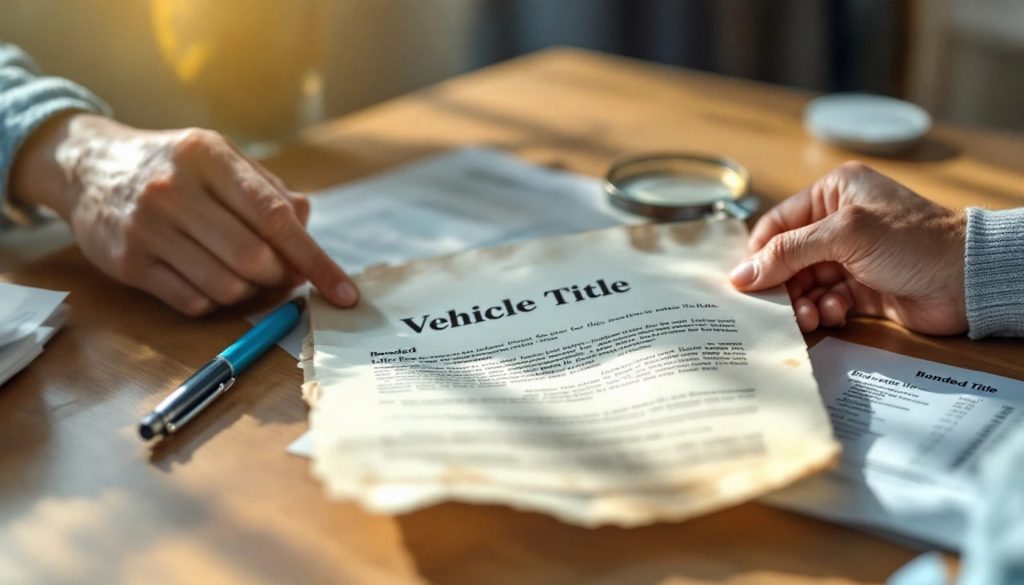
A bonded title is a standard vehicle title issued by the state, but it comes with a surety bond attached. The bond acts as a financial guarantee. If someone shows up later with a legitimate ownership claim on the vehicle, the bond covers them. After a period of typically three to five years with no claims filed, the bond requirement is removed and you’re left with a clean title.
Surety bonds for vehicle titles are not expensive. Most cost between $100 and $300 depending on the vehicle’s value, because the bond amount is typically set at 1.5x the appraised value of the vehicle, but you only pay a small percentage of that as a bespoke.
Who Needs a Bonded Title?
- Buyers who purchased a vehicle with no title at all
- Owners with a title that can’t be verified by the state
- Inherited vehicles where the estate was never properly settled
- Vehicles with an incomplete chain of title due to multiple informal transfers
- Buyers from sellers who can no longer be reached
How to Get a Bonded Title (General Process)
- Get a vehicle appraisal to establish the current market value
- Purchase a surety bond for 1.5x that value from a licensed bond provider
- Complete your state’s bonded title application
- Submit the bond, application, any available paperwork, and the required fee to your DMV
- Receive a bonded title, usually stamped “Bonded” on the face
- After the state-mandated period (commonly 3 years), apply for a clean title
Not every state offers bonded titles. Montana and South Dakota both have workable pathways for titles with ownership gaps, which is one reason vehicle owners from around the country look at What state can I register my vehicle in without living there? when their home state has limited options.
Montana and South Dakota: Cleaner Paths for Complicated Titles
Montana and South Dakota have become go-to states for vehicle owners dealing with complex title and registration situations. Both states have relatively flexible requirements, low fees, and no sales tax on vehicles, which makes them attractive for all kinds of registration scenarios.
Montana specifically allows vehicle registration through an LLC. If you put your vehicle in an LLC, the LLC becomes the registered owner. This approach is used by collectors, exotic car owners, and RV owners to avoid home-state sales tax and reduce annual registration costs. The Montana LLC registered agent requirement is simplified to meet and many services handle it for you.
South Dakota is the other major player. The state allows non-residents to establish domicile relatively easily, register vehicles with low fees, and process titles without the red tape common in states like California or New York. The South Dakota Division of Motor Vehicles provides clear guidance on their title requirements.
Montana Title and Registration: What Owners Need to Know
Montana has no sales tax, no emissions testing, and no annual inspection requirement for most vehicles. For vehicle title purposes, Montana follows standard documentation requirements but has a track record of working through complex cases, especially older vehicles and those with bill-of-sale-only histories. The Montana Vehicle Title and Registration page outlines the current fee schedule and required documents.
The Montana LLC registration path is well-established. Montana LLC Vehicle Registration: Why It Matters explains how this structure works and why it appeals to owners of high-value vehicles who want to keep long-term ownership costs down.
Bill-of-Sale Vehicles and How to Title Them
A bill-of-sale vehicle is one where the only documentation you have is a handwritten or typed receipt of sale. No title was ever provided. This happens often with older vehicles, off-road equipment, and private sales where the seller had already lost their copy. Some states accept a bill of sale plus a VIN inspection as sufficient to issue a title. Others require a bonded title process on top of that. Montana and South Dakota tend to be more accommodating than high-friction states on this front.
| Title Problem | Most Common Solution | Typical Timeline | Approximate Cost |
|---|---|---|---|
| Lost title (registered owner) | Duplicate title application | 1, 3 weeks | $10, $25 |
| Title never transferred to buyer | Bonded title or court order | 4, 8 weeks | $150, $400 |
| Missing or unreachable seller | Bonded title | 4, 8 weeks | $150, $400 |
| Title jumping (multiple gaps) | Bonded title or state alternative | 6, 12 weeks | $200, $600 |
| Lien not released | Lien release letter + duplicate title | 2, 4 weeks | $0, $50 + duplicate fee |
| Bill-of-sale only | VIN inspection + state application | 3, 6 weeks | $50, $200 |
| Inherited vehicle, no estate action | Affidavit + probate or bonded title | 4, 10 weeks | Varies widely |
Dealing with Liens, Lien Releases, and Open Titles
A lien on a title means a lender has a claim on the vehicle until the loan is paid. When you pay off the loan, the lender is supposed to send you a lien release letter, and you then take that to the DMV to get a clean title. Simple enough, except lenders sometimes move slowly, go out of business, or send the wrong paperwork.
If your lender is no longer in business, you’ll typically need to provide proof of payoff, contact the FDIC or relevant successor institution, and submit a notarized affidavit in most states. This can take time, but the path exists.
Open Titles: Risky for Buyers, Tricky to Fix
An open title is one where the seller signed the transfer section but left the buyer’s name blank. It’s sometimes sold this way intentionally to allow a quick resale without re-titling. Open titles are a form of title jumping and are not compliant in most states. If you bought a vehicle with an open title, you’ll need to go back to the most recent named title holder and have them complete a proper transfer. If that person is unavailable, the bonded title route applies here too.
For a practical breakdown of avoiding these situations when buying from another state, How to Avoid Problems Buying a Vehicle From Another State covers what to verify before handing over payment.
You can also find a broader look at trusted DMV processes in trusted DMV solutions, which covers documentation requirements and how a professional service can reduce the back-and-forth with state offices.
When to Use a Registration Service vs. Doing It Yourself
Most straightforward duplicate title requests can be handled directly with your state DMV. But when the situation involves a bonded title, a missing seller, a multi-state issue, or a vehicle title in Montana through an LLC, a professional registration service is worth considering. The paperwork is more involved, the requirements vary by state, and a single mistake can set the process back by weeks.
Dirt Legal handles dmv title transfer paperwork and registration for customers across the country. The process is built for complicated situations, not just the simplified ones. If you want to see how the process works before committing, check out The Digitization of Title and Registration Services, which explains how modern title and registration processes have moved online and what that means for turnaround times.
What a Service Handles That Most People Miss
- Reviewing your documents before submission to catch errors early
- Knowing which state has the most efficient path for your specific situation
- Managing follow-up with the DMV so you don’t have to
- Handling Montana LLC formation if that’s the right route for your vehicle
- Keeping up with changing state requirements so you’re not working from outdated information
Look, most people only deal with a title nightmare once. That means you’re figuring out a process that a registration service works through every day. The time saved often justifies the cost.
Frequently Asked Questions About Fixing Title Problems
How long does it take to get a bonded title?
Most states process bonded title applications within four to eight weeks after you submit complete documentation. That includes your vehicle appraisal, the surety bond certificate, any bill of sale or ownership evidence you have, and the state application form with fees. Some states are faster. California and a few others can take longer. Submitting everything correctly the first time is the biggest factor in timeline, which is why a professional review before submission matters.
Can I sell a car with a bonded title?
Yes, you can sell a vehicle with a bonded title. The buyer will receive the bonded title and take on the same ownership status you had. Some buyers are cautious about bonded titles because of the implied ownership uncertainty, so full disclosure is important. Once the bond period ends and you receive a clean title, the vehicle is easier to sell at full market value.
What is title jumping and why is it a problem?
Title jumping happens when a vehicle changes hands without the buyer completing a proper dmv title transfer into their name before selling again. It’s a problem because it creates gaps in the chain of ownership that are difficult to reconstruct later. Buyers who end up with a jumped title often can’t register the vehicle in their name without additional steps like a bonded title application. Most states impose fines for title jumping, and in repeat or intentional cases, what is the penalty for title jumping can include misdemeanor or felony charges.
What happens if a car has a lien but the lender is out of business?
If your lender closed or was acquired, you’ll need to track down the successor institution, which is often another bank or the FDIC if the lender was federally insured. Request a lien release from them. If no successor can be found, most states allow you to submit a notarized affidavit of payoff along with bank records showing the debt was satisfied. From there, the DMV can issue a clean title. This takes longer than a standard lien release but it’s a solvable problem in every state.
Can I register a car with only a bill of sale?
It depends on the state. Some states, including Montana, have processes for registering vehicles that came with only a bill of sale, especially for older vehicles. Others require a bonded title on top of the bill of sale. The vehicle’s age, value, and history all factor into which process applies. A VIN inspection is almost always required to confirm the physical vehicle matches whatever documentation you do have.
Is a Montana LLC registration still a good option for avoiding sales tax?
Yes. Montana has no sales tax, which makes registering a vehicle through a Montana LLC an effective way to avoid home-state sales tax on high-value vehicles. This approach is used most often for elevated vehicles, RVs, motorcycles, and collector cars. The LLC must be legitimately formed and maintained, including an annual report filing with the Montana Secretary of State. The Montana LLC Annual Report is due April 15 each year. For a full breakdown of the considerations, Key Aspects of Montana RV Registration is a useful resource even if your vehicle isn’t an RV.
Do I need a lawyer to fix a title nightmare?
In most cases, no. The majority of title problems, including lost titles, bonded titles, lien releases, and even some inherited vehicle situations, can be resolved through the DMV process without representation. Complex estate issues or cases where fraud was involved may benefit from an’s review. For everything else, a knowledgeable registration service can work through the paperwork without the cost of counsel.
Your Path Forward With Title Problems
Untangling title nightmares takes patience and the right process, but nearly every title problem has a solution. Whether you’re dealing with lost paperwork, a bonded title situation, a lien you can’t clear, or a gap in ownership from title jumping, the steps exist to fix it. Montana and South Dakota offer accessible paths for difficult cases, and a vehicle registration assistance can save you weeks of back-and-forth with state offices. Don’t let a paperwork problem keep your vehicle off the road longer than it has to. The fix is usually closer than it looks.