
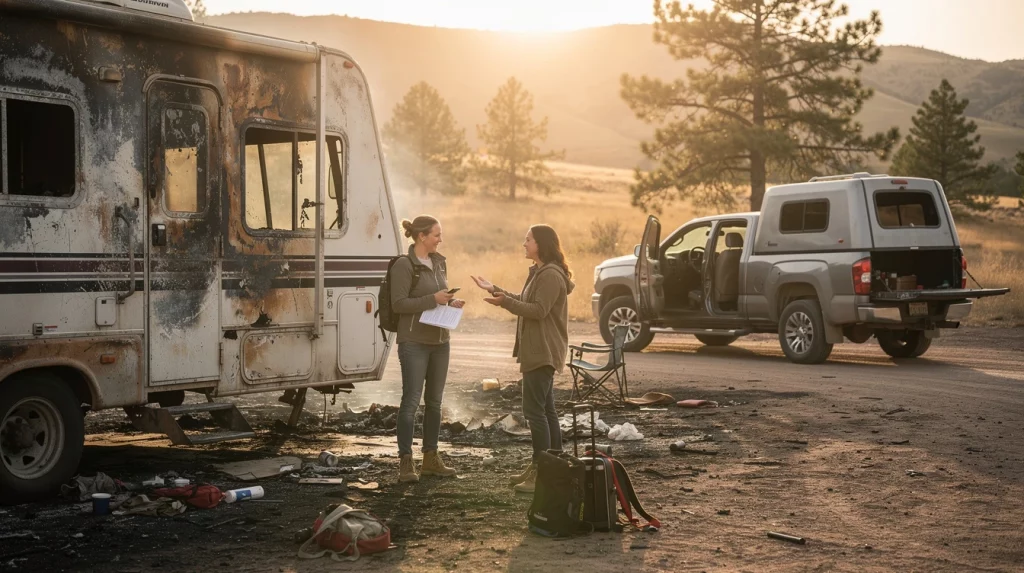
After an RV fire loss, your insurance claim process starts with one critical step: document everything before anything is moved or repaired. Most RV insurance policies cover fire damage under complete coverage, but the payout, the timeline, and what happens to your title depend heavily on how you handle the first 72 hours.
What Does RV Fire Loss Insurance Actually Cover?
complete RV insurance typically covers fire damage caused by engine fires, wildfires, electrical failures, and external sources. It does not usually cover fires caused by mechanical neglect or excluded modifications. Your payout is based on the actual cash value (ACV) of the RV at the time of the loss, minus your deductible.
- complete coverage: Covers fire, theft, weather, and non-collision events
- Agreed value policies: Pay a fixed amount you and the insurer agreed on at policy start, no depreciation deduction
- Actual cash value (ACV) policies: Pay market value at time of loss, which includes depreciation
- Personal property inside the RV: Usually covered under a separate rider or your homeowners policy, not the auto policy
- Total loss threshold: If repair costs exceed a set percentage of the RV’s value (typically 70-80%), the insurer declares a total loss
Honestly, the type of policy you hold matters more than most owners realize until a claim happens. Agreed value policies cost more upfront but remove the depreciation argument entirely.
What Steps Should You Take Immediately After an RV Fire?
The first 48 hours after an RV fire loss set the tone for your entire claim. Moving or disposing of the vehicle before your adjuster inspects it can void coverage or reduce your payout significantly.
Ready to register your vehicle?
Join thousands of vehicle owners who use Dirt Legal to handle their registration quickly and hassle-free.
Register Your Vehicle Today → →- Call 911 and get a fire report. Your insurer will require an official fire department report as part of the claim. Get the report number on scene.
- Notify your insurance company immediately. Most policies require “prompt notice” of a loss. Waiting days can complicate your claim.
- Document the damage extensively. Photos, video, timestamps. Document every angle before anything is touched.
- Do not authorize repairs or disposal yet. The insurer needs to send an adjuster or authorize a third-party inspection first.
- Secure your title and registration documents. You’ll need these for the claims process. If your title was destroyed in the fire, you’ll need an auto title replacement before your insurer can process a total loss settlement.
- Request a copy of your policy declarations page. Confirm your coverage type, deductible, and any riders before speaking with the adjuster.
- Keep all receipts for lodging and alternative transportation. If your policy includes loss-of-use coverage, these are reimbursable.
A more detailed breakdown of what qualifies as ownership documentation is available in What Is the Best Proof of Vehicle Ownership? A Complete Document Guide. This matters especially if your title burned in the fire.
How Does a Total Loss Settlement Work for an RV?
A total loss declaration means the insurer pays you the vehicle’s value instead of repairing it. The RV’s title then transfers to the insurance company, and you surrender the plates. What happens next depends on your state and whether you had a loan on the RV.
| Scenario | What Happens to the Title | What You Receive | Typical Timeline |
|---|---|---|---|
| Total loss, no loan | Title transfers to insurer; salvage title issued | ACV or agreed value payout minus deductible | 2-4 weeks |
| Total loss, active loan | Lender paid first, you receive any remainder | Settlement minus loan payoff balance | 3-6 weeks |
| Partial loss, repairable | Title stays with you | Repair cost reimbursement minus deductible | 1-3 weeks |
| Total loss, owner retains salvage | Salvage title issued to you | Reduced payout; you keep the RV for parts or rebuild | 2-4 weeks |
If your RV was registered through a Montana LLC vehicle registration, the title is held in the LLC’s name. The insurance settlement and title transfer process works through the LLC rather than your personal name. Make sure your insurance policy reflects the LLC as the named insured, not just you personally.
For owners who had their motorhome registered in Montana, the Register Your Motorhome in Montana: The Complete Guide covers how title and registration interact with out-of-state filings, which is relevant when closing out a total loss claim.
What Happens to Your RV Registration After a Fire Loss?
Once a total loss is declared, your RV registration is effectively cancelled. You’re typically required to return your license plates to the state DMV. If you had a Montana plates setup through an LLC, the LLC’s registration is closed out separately.
- Return your plates: Most states require plate surrender after a total loss. Montana is no exception.
- Cancel registration: Notify your state’s motor vehicle division to stop any ongoing registration fees or renewal notices.
- Request a registration refund: Many states prorate unused registration months. South Dakota, for example, allows pro-rated refunds on vehicle registrations. Check the South Dakota Division of Motor Vehicles for details.
- Close or transfer the LLC: If your RV was held in a Montana LLC and you’re not replacing the vehicle, you may want to dissolve or repurpose the LLC. See guidance on The Complete Guide to Forming a Montana LLC for Vehicle Registration for LLC maintenance steps.
One thing that frequently causes delays in the title transfer process after a total loss is odometer compliance, which is the most frequent reason documents come back for correction in our process (internal data, rolling last 90 days, n=108). Get that documented correctly upfront.

Should You Buy Another RV After a Fire Loss? Registration Options Explained
If you’re replacing your RV, you have options on where and how to register the new unit. Owners who registered their previous RV through a Montana LLC often ask whether they should continue with that structure. Short answer: yes, if the reasons still apply to your situation.
- Montana LLC registration: No state sales tax, no emissions testing, no inspections required. Especially relevant for high-value motorhomes. See Montana RV Registration options from our sister brand for details on the process.
- Vehicle registration costs: Montana’s registration fees are based on vehicle age and weight, not purchase price. Costs are typically much lower than high-sales-tax states.
- South Dakota option: Another low-cost state for RV registration, particularly popular with full-time RVers establishing domicile.
- Your home state: If your RV is primarily used and stored in your home state, check local requirements before choosing out-of-state registration.
For a side-by-side look at how Montana registration works for non-residents, How to Register a Car in Montana Without Living There (The Complete Montana LLC Method) walks through the full process.
Frequently Asked Questions About RV Fire Loss Insurance
Does RV insurance cover everything inside the motorhome during a fire?
Standard RV insurance typically does not cover personal belongings inside the RV. Clothing, electronics, and valuables are usually excluded from auto policies and require a separate personal property rider or coverage under your homeowners or renters policy. Always confirm with your insurer which items are covered before a loss occurs.
What if my RV title was destroyed in the fire?
You’ll need to obtain a duplicate title before your insurer can process the total loss settlement. The replacement title process varies by state. If your RV was registered in Montana, you can request a replacement title through the Montana Motor Vehicle Division. Dirt Legal provides paperwork support for auto title replacement to speed this up.
Can I keep my RV after a total loss fire claim?
Yes. You can request to retain the salvage after a total loss. Your insurer will reduce the settlement by the salvage value of the RV. You’ll receive a salvage title, and rebuilding or selling the vehicle for parts is possible. However, getting a rebuilt title on a fire-damaged RV is a significant process that varies by state.
How long does an RV fire insurance claim take to settle?
Most RV total loss fire claims settle within 2-6 weeks after the adjuster’s inspection and documentation are complete. Delays typically happen when title documents are missing, the loan payoff amount takes time to confirm, or the insurer disputes the vehicle’s value. Having clean title documentation upfront cuts the timeline significantly.
Does a Montana LLC registration affect my RV insurance claim?
It can, if your policy isn’t set up correctly. The LLC must be listed as the named insured on the policy, since the LLC holds title to the vehicle. If your personal name is the only named insured and the LLC holds the title, the claim may face complications. Talk to your insurance agent when you first set up Montana LLC registration.
What is a VIN inspection and do I need one for a replacement RV?
A VIN inspection verifies that a vehicle’s identification number matches its title and registration records. You may need one when registering a replacement RV, especially if purchasing from a private party or across state lines. Read more in VIN Inspections: What They Are, When You Need One, and How to Pass.
Disclaimer: This article is for informational purposes only and does not constitute insurance or financial advice. Consult a licensed insurance professional for guidance specific to your policy and situation.