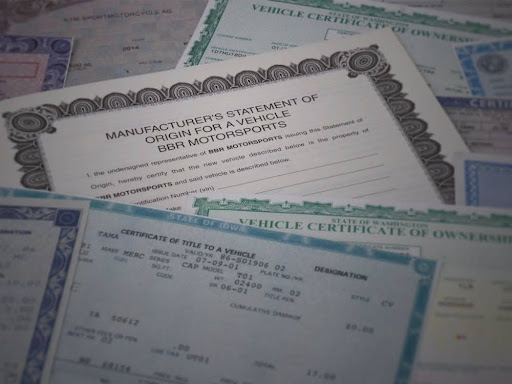
If you’ve ever bought a new car, ATV, motorcycle, or trailer and someone handed you a Certificate of Origin, you probably had a few questions.
“Is this like a title?”
“Can I transfer this to someone else?”
“Do I need to keep this in my glove box?”
Let’s clear it up: you don’t really transfer a Certificate of Origin — you use it to get the first title issued for the vehicle.
Here’s how the whole thing works, who handles it, and what to do if you’re holding one right now.
What Is a Certificate of Origin (MCO/MSO)?
Think of the Manufacturer’s Certificate of Origin (MCO) or Manufacturer’s Statement of Origin (MSO) as your vehicle’s birth certificate.
This document comes straight from the manufacturer and includes the vehicle’s:
- VIN
- Year, make, and model
- Manufacturer’s official info
- Statement that the vehicle meets all applicable standards
It proves that the vehicle is brand new and has never been titled. And it’s the one and only document that gets you that very first title through your DMV or tag agency.
So it’s a big deal — but it’s also a one-time-use document. Once it’s been submitted and the DMV issues a title, the MCO is done. Finished. Retired.
Want to dive deeper? Check out our full breakdown on What a Vehicle’s Certificate of Origin Is and Why It’s Needed — it’s packed with extra examples and scenarios.
Who Actually Holds the Certificate of Origin?
Here’s what surprises a lot of folks: if you bought your vehicle from a dealership, you probably never even saw the MCO.
That’s because the manufacturer doesn’t send it to you — they send it to the franchised dealer who ordered the vehicle. From there, the dealer either keeps it in their records or passes it along to the next dealer if it’s being resold.
In a typical dealership sale, the dealer uses the MCO to apply for your title and registration on your behalf. You get a title in the mail, and the MCO disappears into the system.
Dealer-to-Dealer Transfers: The Paper Trail You Never See
Let’s say a vehicle gets passed from one dealer to another before it ever hits a showroom. That happens more often than you’d think.
In these cases, the Certificate of Origin acts as a kind of paper trail, and every dealer who touches the vehicle fills out a reassignment section on the back of the MCO.
Each entry includes:
- Selling dealer’s name
- Buying dealer’s name
- Date of transfer
- Purchase details
This maintains an unbroken chain of custody from the factory to the eventual buyer. Some states limit the number of dealer reassignments allowed on a single MCO, and if you run out of space, you’ll need a separate dealer reassignment form.
The whole goal? Keeping everything traceable until that first title is created.
Dealer-to-Consumer: Turning the MCO into a Title
Here’s where things go from back-of-house to front-counter.
| Dealer Process: From MCO to Title | |
|---|---|
| Step 1 | Dealer fills in the buyer’s info on the MCO (or an attached reassignment form). |
| Step 2 | You, the buyer, sign a title application — like Florida’s HSMV 82040. |
| Step 3 | Dealer gathers all required documents: |
| • MCO | |
| • Bill of sale | |
| • Odometer disclosure | |
| • Your ID | |
| • Proof of insurance (if required) | |
| • Sales tax and title fees | |
| Step 4 | Dealer submits the package to the DMV or tag agency. |
| Step 5 | DMV issues the first title — paper or electronic, depending on your state. |
After that? The MCO is absorbed into the system and will never be used again. From here on out, all ownership transfers are done via the title.
What If You Have the Certificate of Origin?
This is where it gets interesting.
Let’s say you bought:
- A dirt bike or off-road ATV
- A kit car
- A small trailer or camper
- A low-speed electric vehicle
In cases like these, the seller — whether a dealer or manufacturer — might hand you the MCO directly instead of titling it for you.
Now what?
You’ll need to bring the following to your local DMV or tag agency:
- The original MCO/MSO
- A bill of sale with both parties’ info and purchase details
- A completed title application
- Your ID
- Proof of insurance, if required in your state
Some states also require the bill of sale or the MCO itself to be notarized, especially when it’s your first time registering the vehicle.
That’s why it’s a good idea to check your state’s DMV website before heading in — every state does it a little differently, and showing up with the wrong documents can mean a wasted trip.

Frequently Asked Questions
What to do with a Certificate of Origin for a vehicle?
If you’re holding a Manufacturer’s Certificate of Origin (MCO/MSO), your next move is to use it to apply for the first title.
Head to your local DMV or tag office with:
- The original MCO
- A bill of sale
- Completed title application
- Your ID
- Proof of insurance (if required in your state)
Once your application is processed, the MCO is surrendered and converted into a title — from then on, you’ll use the title for any future transfers.
Can a Certificate of Origin be used as a title?
Not exactly. A Certificate of Origin isn’t a title, but it’s what you use to get the first title.
It proves the vehicle is brand new and has never been registered. Once you submit the MCO to your DMV along with the required paperwork, they’ll issue an official state title in your name.
After that point, the MCO is no longer valid or used — all future transfers will be done with the title.
Want Even More Vehicle Registration Tips?
We don’t just blog — we answer real questions from real people every day. Check out our Quora profile, where we dive into everything from Montana registrations to title hacks for unique vehicles.
We’re building a hub of helpful answers.
So, can you “transfer” a Certificate of Origin?
Not really — not like you would a title. The MCO is a first-step document that gets traded around by dealers and then handed to the DMV to produce the vehicle’s first official title.
If you’re holding one right now, congratulations — you’re the first link in the ownership chain. Now it’s just a matter of connecting the dots at your DMV.
Still have questions about MCOs? We’ve got you covered with this article:
What Is a Vehicle’s Certificate of Origin (MSO/MCO), and Why Is It Needed?
Still Holding an MCO and Not Sure What to Do Next?
If you’ve got a Certificate of Origin but no title in your name, we can help you turn that paperwork into plates — fast.
We’ve helped thousands of drivers across all 50 states navigate DMV red tape and avoid delays. Whether you’re working with a new build, a kit car, or a vehicle handed off with just an MCO, we know what to do.
We’re here to make vehicle paperwork less confusing — and way faster. Let’s get you on the road.
Click here to connect with a title recovery specialist and start your process today.