
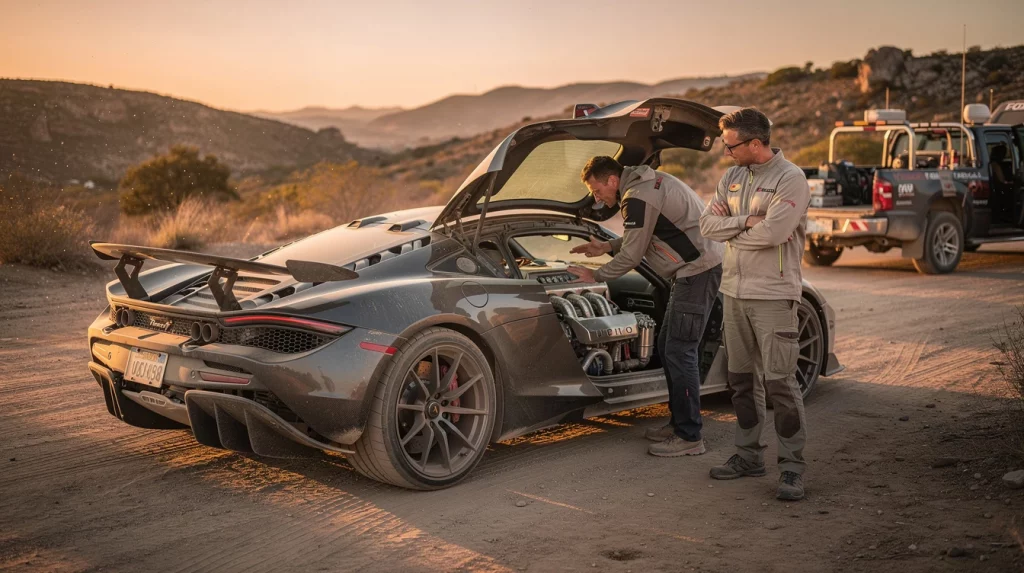
V14 engines are technically possible but practically pointless for supercars, because the engineering compromises, packaging constraints, and cost far outweigh any performance gains over a well-tuned V12. The V12 already sits at the sweet spot of power, balance, and drivability, and going to 14 cylinders breaks that balance without giving you anything useful in return.
What Makes a V12 Engine So Good in High-Performance Supercars?
A V12 is a near-perfect mechanical design. It fires every 60 degrees of crankshaft rotation, which means incredibly smooth power delivery with almost zero vibration. That balance is no accident, it’s the result of two perfect inline-six engines sharing a crankshaft.
- Perfect primary and secondary balance, no counterbalance shafts needed
- High rev potential, V12s can spin to 9,000+ RPM without shaking themselves apart
- Natural aspiration headroom, large displacement without the lag of forced induction
- Emotional soundtrack, the exhaust note of a V12 is a selling point in itself
- Heritage and prestige, Ferrari, Lamborghini, Aston Martin, and Rolls-Royce have built identities around it
The V12’s geometry also allows wide, flat packaging in a mid-engine or front-engine layout. Manufacturers have had decades to perfect it. That’s hard to walk away from.
Why Would Anyone Even Consider a V14 Engine?
The appeal is straightforward: more cylinders, more displacement, more power. A V14 could theoretically produce more torque at lower RPM and offer additional displacement without dramatically increasing bore size. On paper, it sounds compelling.
Ready to register your vehicle?
Join thousands of vehicle owners who use Dirt Legal to handle their registration quickly and hassle-free.
Register Your Vehicle Today → →- More cylinders spread thermal load across more combustion events
- Larger total displacement without oversized pistons
- Potential for higher peak output in naturally aspirated form
But “on paper” is exactly where V14 engines tend to stay. The real-world engineering math doesn’t work out the way enthusiasts hope. Bigger numbers don’t always mean better performance, and in engine design, they often mean bigger problems.
What Are the Real Engineering Reasons a V14 Doesn’t Work Well in a Supercar?
This is where the V14 dream falls apart. The problems aren’t just technical, they cascade across every system in the vehicle. Here are the core reasons engineers consistently pass on the V14 configuration.
The Balance Problem Is Worse Than People Expect
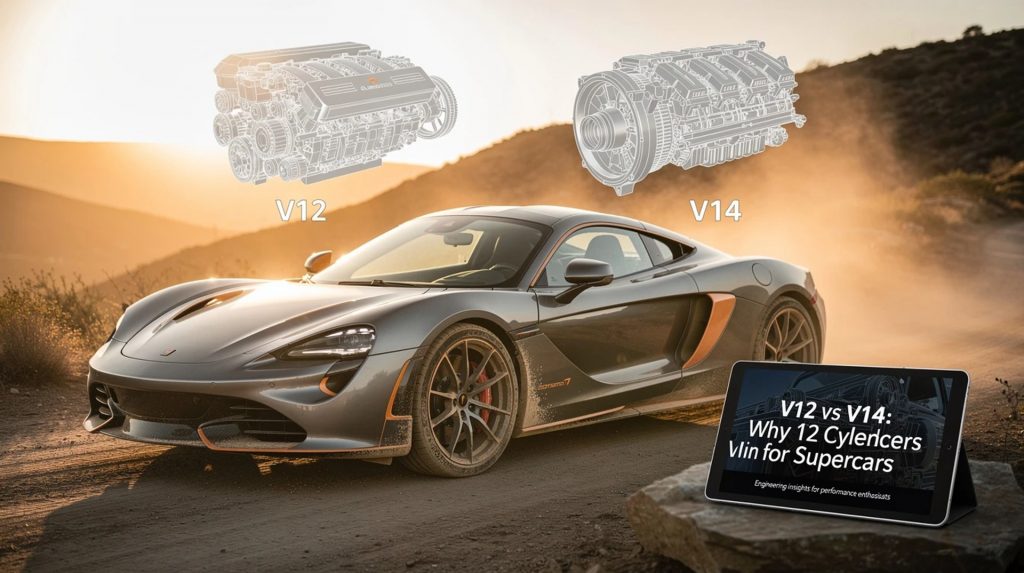
A V12 fires every 60 degrees. A V14 would fire every 51.4 degrees, which is not a number that divides cleanly into the 720-degree combustion cycle. That uneven firing interval creates vibrations that are expensive and heavy to counteract. You’d need balance shafts, which add weight and complexity, eliminating one of the core reasons to use a large multi-cylinder engine in the first place.
The Engine Is Too Long for Any Practical Car
Adding two more cylinders to a V12 makes the engine physically longer. In a mid-engine supercar, that extra length either pushes the firewall into the cabin or extends the rear overhang. Neither option is acceptable in a purpose-built performance car. Wheelbase, weight distribution, and polar moment of inertia all suffer.
The Crankshaft Becomes a Problem
A 14-cylinder crankshaft is long, heavy, and prone to flex under high-RPM loads. Crankshaft flex causes harmonic resonance that limits how high the engine can safely rev. For a supercar, where high RPM is part of the appeal and performance equation, this is a serious constraint.
No Meaningful Power Advantage Over a Turbocharged V8 or V12
Modern turbocharged V8s like the ones in the McLaren 720S produce over 700 horsepower from 4.0 liters. A twin-turbocharged V12 can approach 1,000 horsepower. A naturally aspirated V14 would likely sit somewhere in that range, at far greater cost, weight, and complexity. The power-per-kilogram math simply doesn’t favor 14 cylinders.
| Configuration | Balance Quality | Typical Peak Power | Packaging Challenge | Cost Complexity |
|---|---|---|---|---|
| V8 Twin-Turbo | Good (with balancer) | 600-800+ hp | Low | Moderate |
| V10 NA | Good | 500-640 hp | Moderate | High |
| V12 NA / TT | Excellent (inherent) | 600-1,000+ hp | Moderate | Very High |
| V14 (theoretical) | Poor (uneven firing) | Est. 700-900 hp NA | Very High | Extreme |
Do V14 Engines Exist in Any Vehicles at All?
Yes, but not in supercars. V14 diesel engines appear in large marine vessels and industrial applications, where length and weight aren’t dealbreakers. In those contexts, the smooth torque curve across a wide RPM band is exactly what you want for propulsion. The trade-offs that kill the V14 in a sports car are irrelevant when you’re powering a cargo ship.
- Large marine diesel engines commonly run V14 and V16 configurations
- Industrial generator sets use extended cylinder counts for efficiency at low RPM
- No production road car has ever shipped with a V14
Road vehicles simply have different constraints. Weight, length, NVH (noise, vibration, harshness), and emissions regulations all push manufacturers back toward proven configurations.
How Does This Relate to Registering and Owning a High-Performance Vehicle?
If you’re passionate about supercars, engine architecture, and high-performance vehicles, ownership paperwork is the unsexy part nobody plans for. Exotic cars often come with complex title situations, out-of-state purchases, and registration questions that standard DMV counters aren’t equipped to handle quickly.
One approach enthusiasts use is registering a vehicle through a Montana LLC, which removes sales tax obligations in many scenarios and keeps the registration process clean. If you’ve bought a high-value vehicle and want to understand your options, The Complete Guide to Forming a Montana LLC for Vehicle Registration covers exactly how the process works from entity formation to plates.
For collectors protecting six-figure assets, the sister brand article on LLC vehicle ownership for collectors breaks down why holding vehicles in an LLC makes financial sense beyond just registration savings. And if you’re curious how owners protect exotic cars from depreciation, this piece on protecting exotic cars from depreciation is worth reading before your next purchase.
Dirt Legal has helped 80,000+ vehicle orders to date, including many high-value performance vehicles that required careful title and registration handling (internal data, lifetime through current month, n=5,245).
For anything title-related, whether you’re dealing with a supercar purchase, an out-of-state transfer, or a vehicle without clean paperwork, understanding what makes a vehicle title invalid can save you from a costly mistake later.
FAQ: V12 vs V14 Engines and Supercar Engineering
Has any manufacturer ever prototyped a V14 road car engine?
No major automaker has publicly produced or disclosed a V14 prototype for a road vehicle. The engineering obstacles, particularly the uneven firing interval and excessive engine length, make it a non-starter for production cars. V14 configurations exist only in marine and industrial diesel applications where those trade-offs don’t matter.
Why do V12 engines sound better than smaller engines?
V12s fire 12 times per crankshaft revolution at higher RPM, creating a dense, high-frequency exhaust note that sounds smoother and more intense than a V8. The even firing intervals mean no irregular pops or gaps in the sound. That sonic quality is a core part of the brand identity for Ferrari, Lamborghini, and Aston Martin.
Are V12 engines still being made in new supercars?
Yes, though the list is shrinking. Ferrari’s 812 Competizione, Lamborghini’s Aventador successor, and Aston Martin’s V12 Vantage all use naturally aspirated V12s. Emissions regulations are forcing some manufacturers toward hybridized V12s or smaller turbocharged alternatives, but the V12 hasn’t disappeared from production yet.
What’s the most cylinders ever used in a production road car?
The W16 engine in the Bugatti Veyron and Chiron holds that record for production road cars. It combines four cylinder banks of four cylinders each. No V14 has ever reached production. The W16 works partly because its compact W configuration avoids the length problem that kills the V14 layout.
Does engine configuration affect how a car is registered or titled?
Engine configuration doesn’t directly change the registration process, but high-value supercars with exotic powerplants often carry higher assessed values, which can affect fees and tax treatment by state. Using a Montana LLC vehicle registration is a common approach for exotic car owners to manage those costs compliantly.
What’s the difference between a V12 and a flat-12 engine layout?
A V12 has two banks of six cylinders at an angle, typically 60 degrees. A flat-12 (or boxer-12) has opposing cylinder banks at 180 degrees, sitting much lower in the chassis. Ferrari used a flat-12 in Formula 1 and the 512 BB road car. Both share excellent balance, but flat-12s are rarer due to width constraints.
Own a high-performance vehicle and want to get it registered the smart way?
Start Your Vehicle Registration Today →