

Getting a REAL ID means visiting your state DMV with proof of identity, residency, and Social Security, then receiving a star-marked license or ID card that federal agencies accept for domestic air travel and federal facility access. The process is straightforward, but missing even one document will send you home empty-handed.
What Is a REAL ID and Why Do You Need One for Travel?
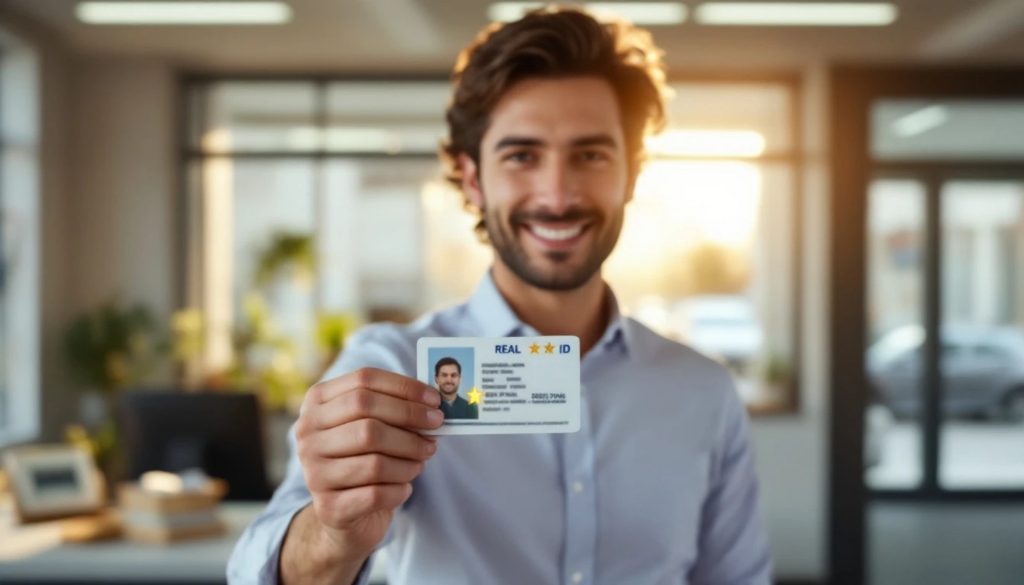
A REAL ID is a state-issued driver’s license or ID card that meets federal security standards set by the REAL ID Act of 2005. Starting May 7, 2025, you’ll need one to board domestic flights and enter certain federal buildings, or you’ll need a passport instead.
Not every license qualifies. Look for a gold or black star in the upper corner of your card. No star means you have a standard license that won’t pass TSA checkpoints after the enforcement deadline.
- Accepted for: Domestic flights, military bases, nuclear power plants, federal courthouses
- Not accepted for: International travel, customs border crossings (use a passport)
- Enforcement date: May 7, 2025
- Who issues it: Your state DMV, not a federal agency
What Documents Do You Need to Get a REAL ID?
Every state requires the same four document categories to issue a REAL ID. You must bring originals or certified copies, not photocopies.
Ready to register your vehicle?
Join thousands of vehicle owners who use Dirt Legal to handle their registration quickly and hassle-free.
Register Your Vehicle Today → →- Proof of identity: U.S. birth certificate, U.S. passport, or permanent resident card
- Proof of Social Security number: Social Security card, W-2, or SSA-1099
- Two proofs of state residency: Utility bill, bank statement, mortgage statement, or vehicle registration
- Proof of any legal name change: Marriage certificate or court order (if your name differs from your birth certificate)
Honestly, the residency documents trip up the most applicants. A vehicle registration document counts as valid proof of address in most states, so make sure yours is current. If your registration is out of date, that’s one more thing to sort out before your DMV visit.
A more detailed breakdown of what counts as valid vehicle ownership proof is available in What Is the Best Proof of Vehicle Ownership? A Complete Document Guide. That resource covers which documents carry the most weight at state agencies.
How Much Does a REAL ID Cost and How Long Does It Take?
REAL ID fees vary by state, but most fall between $30 and $60 for a standard license upgrade. Processing is usually same-day at the DMV counter, though the physical card arrives by mail in 1-3 weeks.
| State | REAL ID Fee (Approx.) | Card Delivery Time | Appointment Required? |
|---|---|---|---|
| California | $35 | 3-4 weeks | Recommended |
| Texas | $33 | 2-3 weeks | Yes |
| Florida | $32 | 2 weeks | Recommended |
| Montana | $29 | 1-2 weeks | Walk-in OK |
| South Dakota | $28 | 1-2 weeks | Walk-in OK |
| New York | $80+ | 3-4 weeks | Yes |
Montana and South Dakota tend to have shorter wait times and lower fees than high-population states. Vehicle registration costs in those states also run lower, which is one reason many vehicle owners find those states worth paying attention to. You can see a full breakdown of Montana Plates: Your Complete Guide to Options, Costs, and Registration if you’re thinking about Montana-based registration.
Can You Use a REAL ID Instead of a Passport for Domestic Travel?
Yes. A REAL ID-compliant driver’s license or state ID card fully replaces a passport for domestic flights within the United States. It does not replace a passport for international travel or border crossings.
TSA accepts any REAL ID-compliant document at airport security checkpoints. Your options at a checkpoint include:
- REAL ID-compliant state driver’s license or ID card (marked with a star)
- U.S. passport or passport card
- DHS trusted traveler card (Global Entry, NEXUS, SENTRI)
- U.S. military ID
- Enhanced driver’s license (available in select states)
A standard driver’s license without the star marking will not be accepted at TSA checkpoints after May 7, 2025. Check your wallet now.
How Does Vehicle Registration Relate to Getting a REAL ID?
Your vehicle registration counts as a proof-of-residency document in most states, which makes it directly relevant to your REAL ID application. An expired or mismatched registration can create complications at the DMV counter.
Here’s why this matters practically:
- Your registration must show your current address to count as valid residency proof
- If your name on the registration differs from your other documents, it can trigger additional review
- Out-of-state registrations may not Eligible as residency proof in your home state
Vehicle owners who register a car in Montana without living there through a Montana LLC should understand that their Montana registration document shows an LLC address, not a personal residential address. That’s fine for the vehicle’s registration purposes, but you’d use a different document, such as a utility bill or bank statement, as your personal address proof for the REAL ID application.
If you’re thinking about the Montana LLC registration path for your vehicle, The Complete Guide to Forming a Montana LLC for Vehicle Registration walks through the full process, including how the LLC owns the vehicle rather than you personally.
Getting your vehicle paperwork right the first time matters. Whether you’re registering through a Montana LLC vehicle registration path or simply keeping your home-state registration current, accurate documents protect you at every agency interaction, including the REAL ID counter.
Step-by-Step: How to Get Your REAL ID at the DMV
The process takes one in-person visit and typically under an hour if you come prepared. Here’s the exact sequence:
- Check your current license: Look for a star. If you already have one, you’re set until renewal.
- Gather your documents: Birth certificate (or passport), Social Security card, two residency proofs, and any name-change documents.
- Schedule an appointment: Many states now require one. Check your state DMV website before walking in.
- Visit the DMV in person: REAL IDs cannot be renewed online. You must appear in person at least once.
- Pass the document review: A DMV clerk verifies every document. Original documents only, no photocopies.
- Pay the fee: Typically $28-$80 depending on your state.
- Receive your temporary paper license: Your REAL ID card arrives by mail in 1-3 weeks.
Look, the only thing that derails most people is showing up with the wrong documents or copies instead of originals. Double-check the list for your specific state before you go.
For readers managing both a vehicle title transfer and a REAL ID update at the same time, the What Makes a Vehicle Title Invalid? post is worth a read. Sorting out any title issues before your DMV visit keeps everything cleaner.
Frequently Asked Questions
Can I fly domestically without a REAL ID after May 2025?
Yes, but only if you use an acceptable alternative, such as a U.S. passport, passport card, or a DHS trusted traveler card like Global Entry. A standard state driver’s license without the star marking will not be accepted at TSA checkpoints after May 7, 2025. A passport is the most common backup option.
Do children need a REAL ID to fly?
Children under 18 are not required to show ID when traveling domestically with an adult companion. TSA does not require identification for minors on domestic flights. Adults accompanying the child must still present a REAL ID or acceptable alternative at the security checkpoint.
Can I use a REAL ID for international travel or crossing into Canada or Mexico?
No. A REAL ID is only valid for domestic U.S. travel and access to certain federal facilities. For international travel, border crossings into Canada or Mexico, or re-entry into the United States, you need a valid U.S. passport, passport card, or an enhanced driver’s license if your state issues one.
What happens if my REAL ID application is rejected at the DMV?
The DMV will tell you exactly which document failed review. Most common reasons are missing an original certified birth certificate, using a photocopy instead of an original, or mismatched names between documents. You simply reschedule and return with the correct documents. Same fees apply for a new visit.
Does my vehicle registration address have to match my REAL ID address?
Not necessarily. A vehicle registered through a Montana LLC, for example, carries the LLC’s Montana address. Your personal REAL ID application uses your personal residential address. These don’t need to match each other, but both need to be accurate on their respective documents.
How long is a REAL ID valid?
REAL IDs follow your state’s standard driver’s license renewal cycle, typically four to eight years depending on your state. You’ll renew it the same way you renew a regular license. After your first in-person REAL ID upgrade, some states allow online renewals as long as your underlying documents haven’t changed.