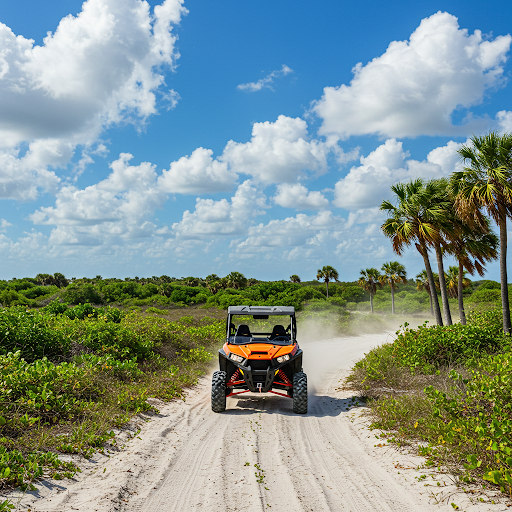
In Florida, UTVs are generally restricted to off-road use, but exceptions exist for specially modified models. State regulations allow certain UTVs to become street-legal if they meet specific safety and equipment requirements.
Florida law states that all-terrain vehicles (ATV) may only be operated on unpaved roadways where the posted speed limit is less than 35 MPH and only during daylight hours. However, a county may choose to be exempt from this, according to Florida Highway Safety and Motor Vehicles.
Off-Highway and All-Terrain Vehicles are titled, but not registered and are not required to be insured with PIP and PDL coverage. To title an ATV, submit a completed form HSMV 82040 to a Motor Vehicle Service Center. (Sections 261.20, 316.2074, and 316.2123, Florida Statutes)
Are UTVs Street Legal in Florida? (Requirements Explained)
In Florida, UTVs are not street legal by default.
However, certain UTVs may become eligible for limited road use if they are properly modified, meet equipment standards, and are classified correctly—often as a Low-Speed Vehicle (LSV).
If you’re trying to avoid trailering your UTV everywhere, understanding these rules is the first step.
Florida UTV Street Legal Requirements
To become eligible for road use in Florida, a UTV typically needs to meet specific equipment standards.
These may include:
Headlights, taillights, and brake lights
Turn signals
Rearview and side mirrors
Horn
Windshield
Seat belts
Speedometer and odometer
DOT-approved tires
In addition to equipment, you may also need:
Vehicle inspection
Proper classification (such as LSV)
Title and registration
Valid insurance
Requirements can vary depending on how the vehicle is classified and where it will be operated.
Insurance Requirements for Street-Ready UTVs
If a UTV is approved for road use, it must meet standard vehicle insurance requirements.
This typically includes:
Liability coverage (property damage and injuries)
Personal Injury Protection (PIP) in Florida
Optional coverage like collision and comprehensive is often recommended but not required.

Where Most Riders Get Stuck
Adding lights and mirrors is only part of the process.
The real challenge is:
Understanding how your UTV needs to be classified
Navigating registration requirements
Dealing with paperwork and inspections
This is where many riders lose time—or give up entirely.
How Dirt Legal Helps
Dirt Legal works with UTV owners to simplify the process of getting vehicles road-ready.
That includes:
Reviewing your vehicle and documentation
Identifying the correct registration pathway
Handling complex paperwork requirements
Instead of trying to piece together state rules on your own, you can move forward with a clear plan.
Florida UTV Resources:
- Florida Department of Highway Safety and Motor Vehicles (DHSMV)
- This official state department handles vehicle registrations and requirements for on-road vehicle use. You can find information on how to register a UTV as a Low-Speed Vehicle (LSV) and the necessary modifications.
- Website: Florida DHSMV
- Phone: (850) 617-2000
- Florida Statutes – Vehicle Code
- You can read the relevant sections of Florida law to understand UTV registration requirements, safety standards, and public road usage.
- Link: Florida Statutes – Motor Vehicles
- Florida’s Low-Speed Vehicle Laws
- Information on Florida’s LSV laws and what makes a vehicle eligible for road use.
- Link: Florida Statutes Title XXIII, Chapter 320
- Florida Off-Highway Vehicle Regulations
- This is for information on off-road vehicles and regulations around use in state parks and designated areas.
- Link: Florida Department of Environmental Protection
- Florida Insurance Requirements for UTVs
- Details on how to get insurance for UTVs used on public roads, including minimum coverage requirements for public road operation.
- Link: Florida Department of Financial Services
- Florida County and Municipal Ordinances
- Some local governments have their own specific regulations for UTV use on public roads. This site links to local ordinances or provides contact info for municipalities.
- Link: Florida League of Cities
- National Off-Highway Vehicle Conservation Council (NOHVCC)
- Although a national organization, NOHVCC offers state-by-state guides and resources on UTV laws and regulations, including Florida. They often provide insights into local rules and areas designated for UTV use.
- Link: NOHVCC
- UTV and OHV Manufacturer Resources
- Many UTV manufacturers provide detailed advice and guides on modifications required to make a UTV street legal, including equipment and inspection requirements. Check the manufacturer’s website or customer support for specific details on road modifications.
- Example: Polaris UTV Road Legal Info
- Off-Road Parks and Trails in Florida
- This is for information on where UTVs are allowed for off-road use in Florida, including designated parks, trails, and areas for recreation.
- Link: Florida State Parks
- Florida Highway Patrol (FHP)
- For any specific road usage inquiries and enforcement of laws related to UTVs on public roads.
- Website: Florida Highway Patrol
- Phone: (850) 617-2301
- National Highway Traffic Safety Administration (NHTSA)
- For general vehicle safety standards that may apply to your UTV modifications and road use.
- Link: NHTSA UTV Information
Stay in the know—subscribe to our newsletter for the latest updates!
Dirt Legal transforms vehicle registration for everyday drivers with digital, hassle-free, and time-saving solutions so you can keep your wallet happy and your vehicle 100% road-ready.
Frequently Asked Questions
Trying to get your UTV road-ready in Florida? From costs to requirements and what’s actually allowed, here are the key answers to help you move forward without getting stuck in complex paperwork.
How do you get a side-by-side (SxS) road-ready?
Getting a side-by-side road-ready usually involves two steps: installing required equipment (like lights, mirrors, and safety features) and completing the proper registration process. The paperwork and classification are where most people get stuck—Dirt Legal helps simplify that process so you can move forward faster.
What is the UTV bill in Florida?
Florida has specific laws governing off-highway vehicles, including where and how UTVs can be used. While they are generally limited to off-road environments, certain updates and classifications have created limited pathways for road use. Staying current on these rules is key—and Dirt Legal helps you navigate how they apply to your situation.
Are there any street-legal side-by-sides?
Yes, some side-by-sides can become road-ready depending on how they are equipped and registered. Not every model qualifies, and rules vary by state, but with the right setup and approach, many owners are able to drive their vehicles on public roads. Dirt Legal helps guide you through the process and handle the complex paperwork involved.