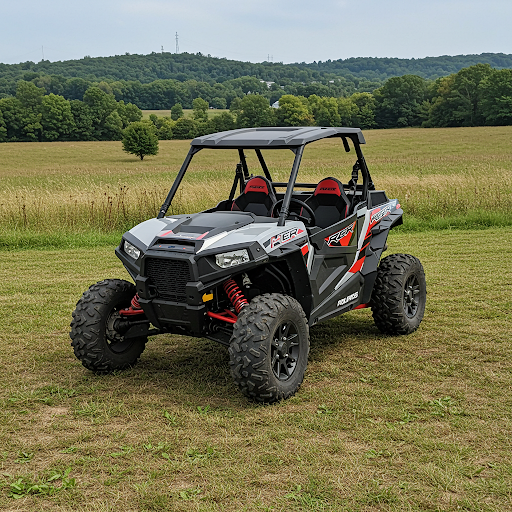
It is possible to operate a UTV on public roads in Maryland by completing registration through another state. The resulting title, registration, and license plate can allow you to drive your side-by-side on roads, highways, and city streets in Maryland and beyond.
This guide covers UTV road access in Maryland from top to bottom, including applicable regulations, OHV areas, and the limited situations when a UTV without road registration can still be operated on local roads.
If you’re ready to get your UTV set up for public roads in Maryland, our expert team can handle the complex paperwork for you.
Why Maryland Cannot Register UTVs for Public Roads
To register a UTV as a normal on-road vehicle through the Maryland Motor Vehicle Administration (MVA), the vehicle would need to meet the state’s definition of a standard motor vehicle and pass a Maryland vehicle inspection.
Maryland regulations do not currently allow this.
Under Maryland statutes, vehicles commonly referred to as UTVs are classified as either:
Off-Highway Recreational Vehicles (Statute 11-140.1), or
All-Terrain Vehicles (Statute 11-103.3)
Vehicles in these categories do not qualify for standard motor vehicle inspection and cannot be registered for normal highway use through the Maryland MVA.
Other potential classifications do not apply either:
Motorcycles require straddle seating and three wheels or fewer.
Autocycles must have two wheels in front and one in the rear.
Because of these definitions, UTVs cannot fit any existing on-road registration category within Maryland.
How to Get Road Registration
Some states — including Montana and South Dakota — allow UTVs to be registered for on-road use.
You can complete registration in those states without leaving your home. Once registration is complete and the required equipment is installed, your UTV can become eligible for public roads in Maryland through out-of-state registration reciprocity.
Imagine loading up your UTV for a weekend trip without needing a trailer. Whether you’re heading to the mountains via Highway 68 through Cumberland or taking the scenic route along Highway 48 in West Virginia, a properly registered UTV gives you the flexibility to drive there directly.
Best of all, our team handles the complex paperwork while you decide where to ride first.
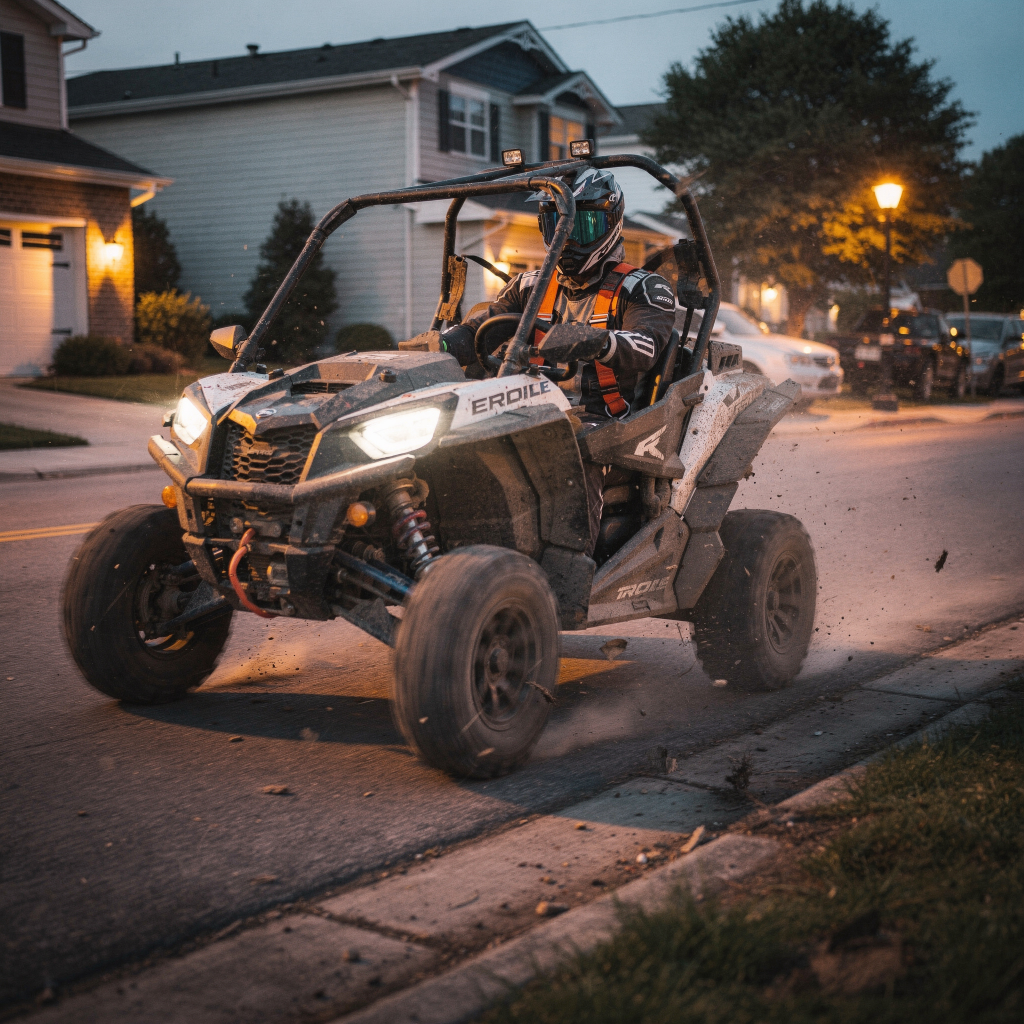
Parts Required for Road Use in Maryland
Because the only way to operate a UTV on Maryland roads is through out-of-state registration, the equipment requirements depend on the state where the vehicle is registered.
Due to reciprocity agreements between states, a vehicle typically only needs to meet the equipment requirements of the state that issued the registration.
This means a UTV with valid out-of-state registration can generally be driven on Maryland roads without:
Installing equipment specifically required by Maryland
Passing a Maryland vehicle inspection
GET ROAD-READY PARTS ON GRITSHIFT
Driving a Road-Ready UTV on Public Roads in Maryland
Because UTVs operating on public roads are still relatively uncommon, local law enforcement officers may not always be familiar with how they can be registered through other states.
For this reason, it’s a good idea to carry:
Your vehicle registration
Proof of insurance
Any supporting documentation showing the vehicle’s registration status
Maryland recognizes registrations issued by other states through reciprocity agreements. As long as the vehicle remains registered elsewhere, it may be operated on Maryland roads.
If your UTV is registered through an out-of-state LLC or you maintain residency in another state, you typically do not need to transfer the registration to Maryland. In fact, transferring the registration may not be possible because of differences in vehicle classifications.
As with any other motor vehicle, operators must follow all normal traffic laws when driving on public roads.
Helmet Laws in Maryland
Maryland does not have a helmet requirement written specifically for UTVs operating on public roads.
However, Maryland does require helmets for motorcycle riders, along with eye protection if the vehicle does not have a windshield.
UTVs do not match the state’s definition of a motorcycle, and the statute also excludes riders “in an enclosed cab.”
Even so, wearing a helmet is generally recommended since it aligns with what local authorities are most accustomed to seeing for open vehicles.
Keep in mind that helmet requirements vary from state to state. Always check the rules for any state you plan to travel in.
Driving in Maryland OHV Areas
Registration
Whether or not your UTV is registered for road use, you must obtain Maryland OHV registration if you plan to operate in:
OHV areas
Public lands
Designated off-road trails
If your UTV already has out-of-state road registration or you are not a Maryland resident, you will need a Maryland Nonresident OHV Registration.
Maryland does not offer reciprocity for off-road registrations, meaning you must still obtain the state OHV decal even if your vehicle is registered elsewhere.
You can obtain this registration through:
The Maryland OHV Registration Portal
Maryland Department of Natural Resources licensing centers
Get your Maryland OHV registration digitally through the Maryland OHV Registration Portal or in person at one of many DNR Licensing Centers
Equipment
Maryland does not enforce a single statewide equipment standard for OHV areas.
However, most riding areas across the United States require:
A Forest Service–approved spark arrester
A functioning muffler with sound levels around 80–90 decibels
Working lights and brakes
Individual OHV areas may have additional requirements related to helmets, engine size limits for younger riders, or other safety equipment. Always check the specific rules for the area you plan to visit.
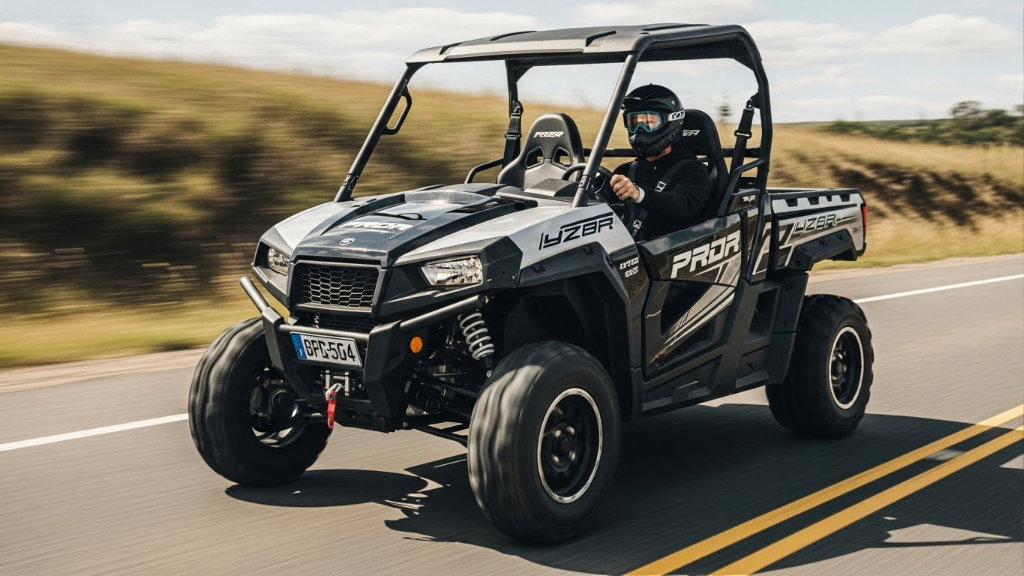
When a Standard UTV Can Be Driven on Maryland Roads
This section applies to UTVs without road registration.
Maryland only allows off-highway vehicles to operate on certain public roads that have been specifically approved by local authorities.
Cities, counties, and towns determine:
Whether OHVs can use local roads
How far they may travel
Speed limits
Whether road crossings are permitted
Some jurisdictions allow very limited road access for connecting trails or crossing streets.
Because these rules vary widely, contact the local municipality where you plan to ride.
Special Exceptions
Certain uses may qualify for different restrictions, including:
Agricultural vehicles
Government operations
Contact the Maryland MVA or local law enforcement for details about these situations.
Some OHV areas may also offer permits allowing vehicles to travel on nearby public roads connected to the trail system.
Laws, Codes, and Other Resources
For questions outside the scope of this guide, try contacting:
These are the sources we used to create this guide. If you find any inaccurate or outdated information, please contact us, and we will be happy to address it.
Operating as an OHV
Maryland OHV Online Registration
Maryland OHV Registration Locations
Road Use of OHVs Not Registered as Street-Legal
Maryland Transportation Statute 11-103.3 (Defines All-Terrain Vehicle)
Maryland Transportation Statute 11-140.1 (Defines Off-Highway Recreational Vehicle)
Maryland Transportation Statute 25-102 (Localities provide OHV laws)
Other Resources
Maryland Transportation Statute 11-103.4 (Defines Autocycle)
Maryland Transportation Statute 11-127 (Defines Highway)
Maryland Transportation Statute 11-136 (Defines Motorcycle)
Maryland Transportation Statute 13-402.1 (Maryland vehicle registration reciprocity)
Maryland Transportation Statute 21-1306 (Maryland motorcycle helmet law)